
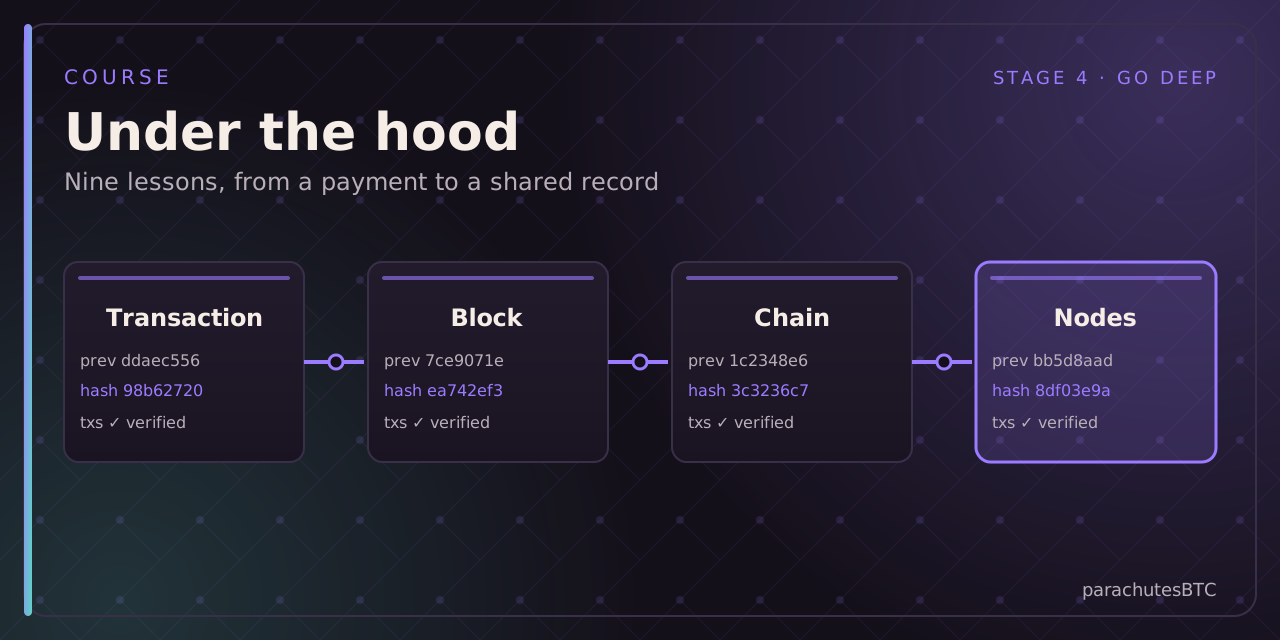
STAGE 4 · GO DEEPLEVEL · Intermediate9 LESSONSABOUT 52 MINNETWORK & MINING
This is the course for people who want to understand the machine, not just use it. Nine lessons walk through the whole system in the order the pieces depend on each other, with a diagram and a check in each. By the end you can read the whitepaper and recognise every part.
BY THE END OF THIS COURSE YOU WILL BE ABLE TO
- Explain the double-spend problem and how Bitcoin solves it
- Trace a transaction from inputs to outputs to confirmation
- Describe what a block contains and why blocks form a chain
- Explain mining, the target and the difficulty adjustment
- Say who enforces the rules and what happens when people disagree
- Read the whitepaper and recognise each section
Every lesson ends with a quiz or a challenge; the course is complete when each lesson is.
0 of 9 lessonsStart the course →
LESSONS
01The problem: double spendingDigital things can be copied, so digital cash needs a ledger. Every system before Bitcoin needed a trusted party to keep it.▶ 1✓ quiz5 MIN✓02Transactions and UTXOsBitcoin has no account balances. It tracks unspent outputs. A payment unlocks whole outputs and creates new ones, with change back to you.▶ 1✓ quiz⚡ challenge6 MIN✓03Keys, hashes and signaturesOutputs are locked to keys. A signature proves the holder authorised one exact transaction without revealing the key. Hashes tie everything together.▶ 1✓ quiz▭ cards6 MIN✓04Blocks and the chainA block is a header plus transactions. The header links to the previous block and commits to every transaction through a Merkle root.✓ quiz6 MIN✓05Mining and proof of workMiners hash block headers until one falls below a target. The work is useless except as proof that it was done, which is exactly what makes history expensive to change.▶ 1✓ quiz⚡ challenge6 MIN✓06The difficulty adjustmentEvery 2,016 blocks the network retunes the target so blocks keep arriving every ten minutes, whatever the hash rate. This keeps issuance on schedule.✓ quiz⚡ challenge5 MIN✓07Nodes, consensus and the longest chainFull nodes verify every rule and reject anything invalid, no matter how much work is behind it. The valid chain with the most work wins.▶ 1✓ quiz6 MIN✓08Fees and the mempoolUnconfirmed transactions wait in each node's mempool. Miners take the highest fee per byte first. Fees are the market for scarce block space.✓ quiz⚡ challenge5 MIN✓09Reading the whitepaperYou now know every concept in the whitepaper. This lesson maps its twelve sections to what you have learned and sends you to read it.▶ 1✓ quiz7 MIN✓