
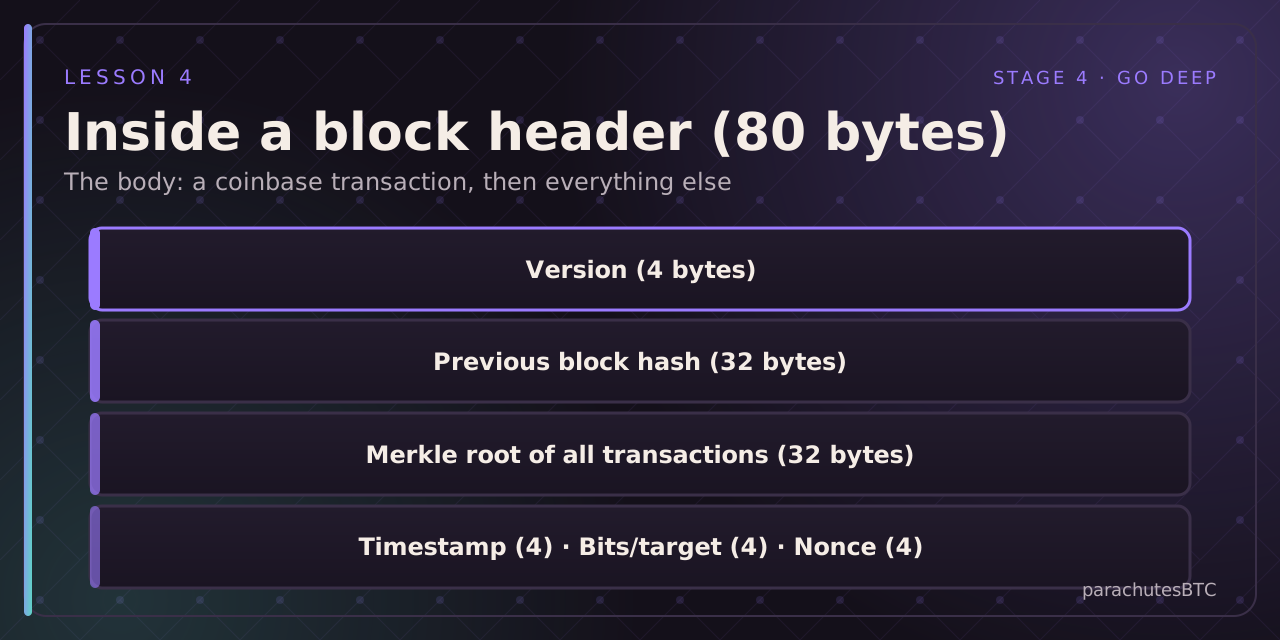
A block bundles transactions and seals them. Its header is only 80 bytes and holds six fields: a version, the hash of the previous block's header, the Merkle root, a timestamp, the difficulty target in compact form, and a nonce.
The chain
Because each header contains the previous header's hash, blocks form a chain back to the genesis block of January 2009. Altering any transaction in an old block changes its Merkle root, so its header hash, so the "previous hash" in the next block, and so on to the tip. You cannot change history quietly; you can only redo all the work that followed.
The Merkle root
Transactions are hashed in pairs, then the pairs are hashed in pairs, up to one root. This lets a light client prove a transaction is in a block with only a handful of hashes instead of the whole block, which is the Simplified Payment Verification the whitepaper describes.
Size and timing
Blocks are found about every ten minutes on average and are limited to 4 million weight units (roughly 1 to 4 MB depending on transaction types). The first transaction in each block is the coinbase, with no inputs, paying the miner the subsidy plus fees.