
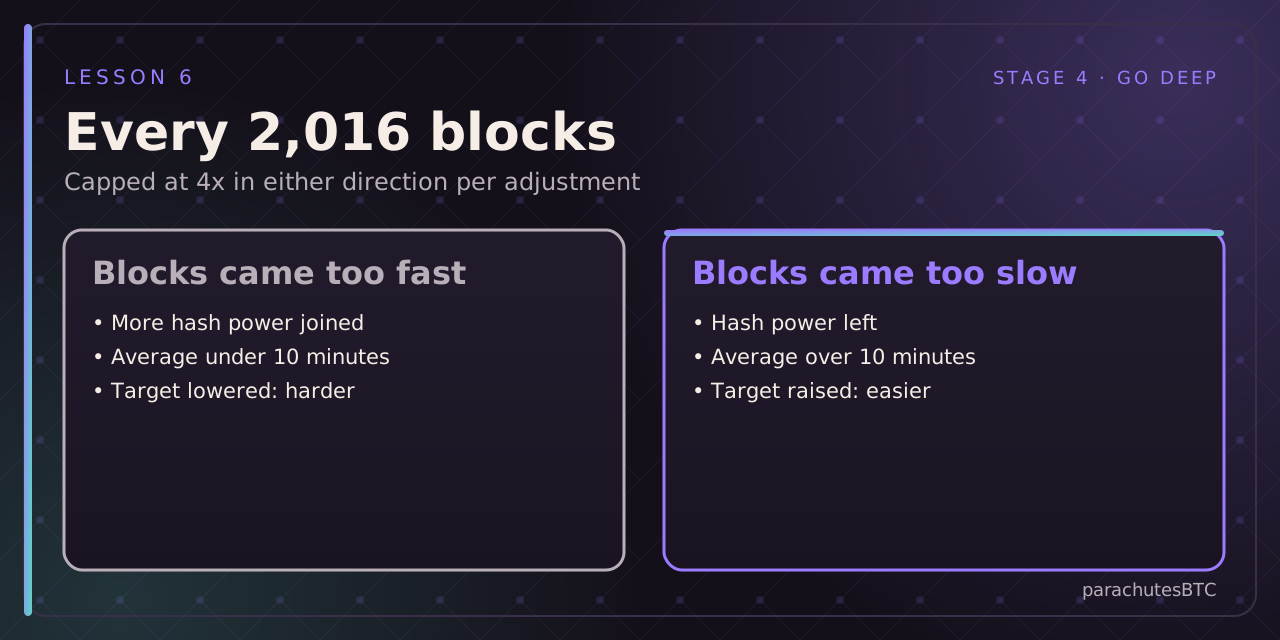
If supply is tied to blocks and blocks are found by hashing, then more hash power would mean more blocks and faster issuance. Bitcoin prevents that with a thermostat.
The rule
Every 2,016 blocks (about two weeks at ten minutes each), nodes compare how long those blocks actually took with the expected 20,160 minutes. If they came in 18,000 minutes, the target is lowered by that ratio so the next 2,016 take longer. Any single adjustment is capped at a factor of four up or down. Every node computes this independently from the block timestamps; no one sets it.
Difficulty versus target
The target is the number a hash must be below. Difficulty is a human-friendly way of saying how far the target has moved from the original: difficulty = max target ÷ current target. Block 100,000 had a difficulty of about 14,484; today it is in the tens of trillions.
What it gives Bitcoin
- Issuance on schedule regardless of how much hardware exists.
- Resilience. If half the miners vanished, blocks would slow for a while and then difficulty would fall and restore ten-minute blocks.
- Security that scales with price. Higher prices attract more miners, raising difficulty and the cost of attack.
Watch it live on the Bitcoin Charts dashboard under Mining.
The last 2,016 blocks took 16,128 minutes instead of 20,160. By what factor does difficulty increase? (Expected ÷ actual.)