
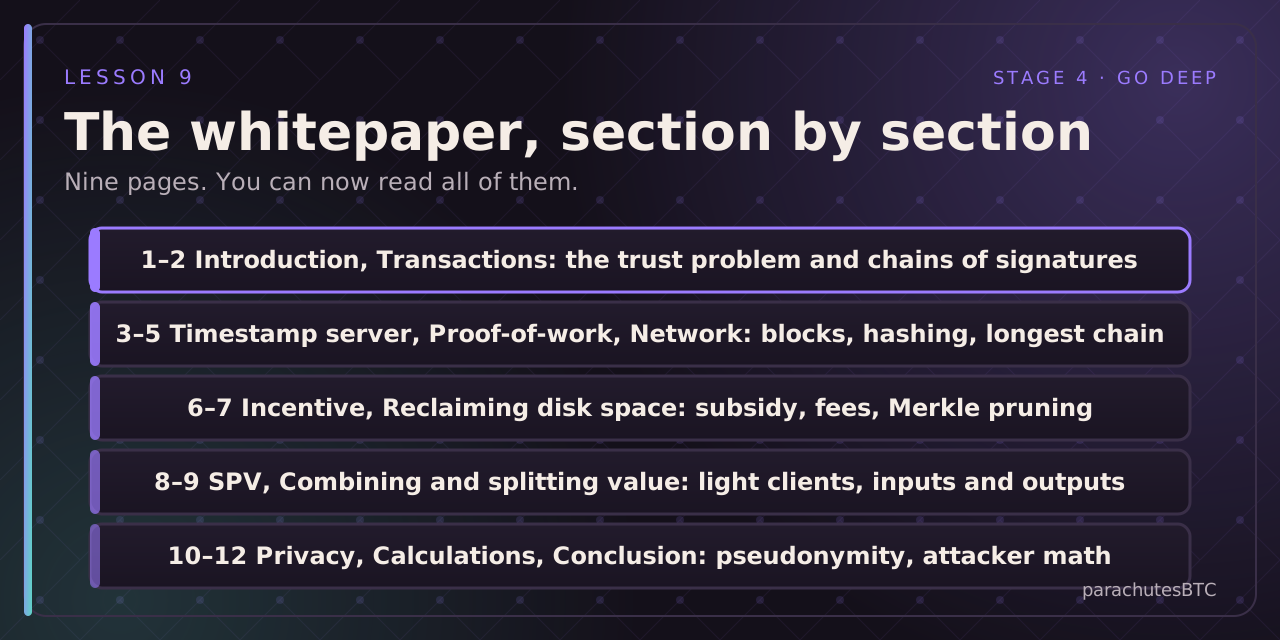
The whitepaper is nine pages and you now know every idea in it. Read it with this map.
Sections 1 to 2: the problem and the chain of signatures
The introduction names the cost of trusted third parties and proposes "an electronic payment system based on cryptographic proof instead of trust". Section 2 defines a coin as a chain of digital signatures: each owner signs the hash of the previous transaction and the next owner's public key. That is lesson 3.
Sections 3 to 5: timestamps, proof of work, the network
A timestamp server hashes items into a chain so each proves the previous existed. Proof-of-work (section 4) is the nonce-and-target mechanism, with the famous line that it is "one-CPU-one-vote" and that the longest chain represents the majority decision. Section 5 is the network: broadcast, collect into a block, find the proof, accept the block only if all transactions are valid, build on it. Lessons 4 to 7.
Sections 6 to 7: incentive and disk space
The first transaction in a block creates new coins ("adds an incentive for nodes to support the network"), and later fees take over, "completely inflation free" once the supply is out. Section 7 is the Merkle tree and pruning old transactions. Lessons 4 and 8.
Sections 8 to 9: light clients, and inputs and outputs
Simplified Payment Verification lets a client check a payment with block headers and a Merkle branch. Section 9 describes transactions with multiple inputs and at most two outputs: the payment and the change. Lesson 2.
Sections 10 to 12: privacy, the attacker's odds, conclusion
Privacy is by keeping public keys anonymous and not reusing them. Section 11 computes the probability an attacker catches up from z blocks behind: it drops exponentially, which is the math behind "six confirmations". The conclusion: "a system for electronic transactions without relying on trust."
Read it here: bitcoin.org/bitcoin.pdf. Then try the monetary policy course or go deeper with Keys, addresses and Script.