
Bitcoin's rules change rarely, but the arguments never stop. These are the ones you will hear in 2026.
Covenants
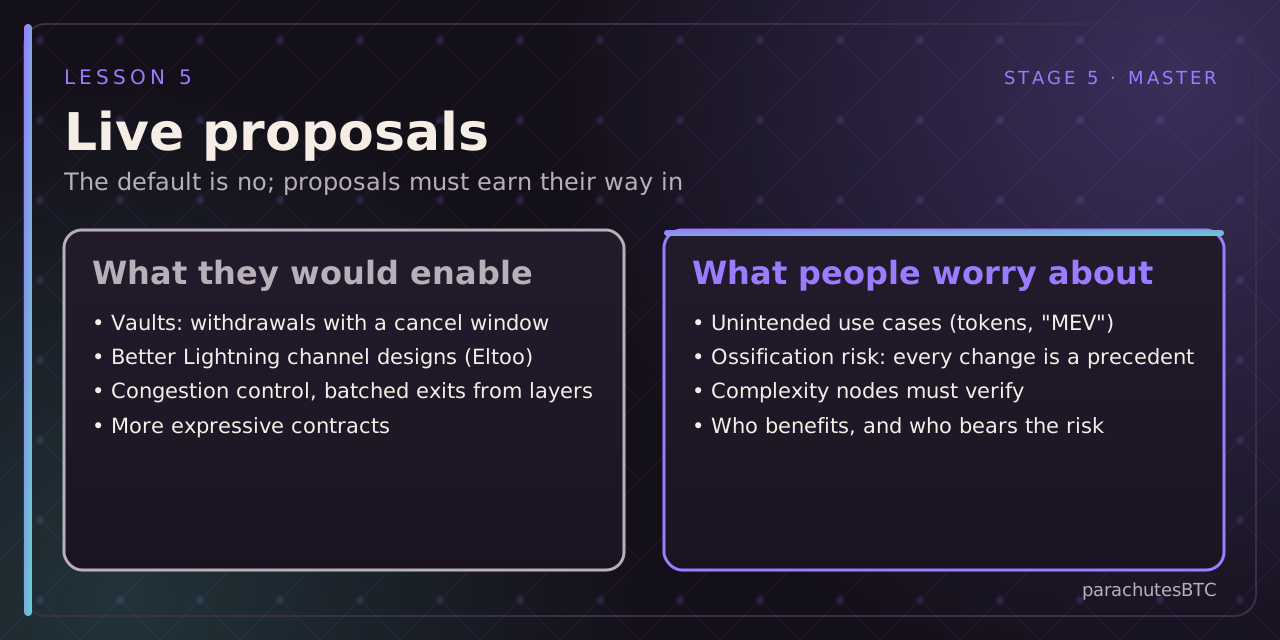
A covenant is a script that restricts how its coins can be spent in the next transaction, not just who can spend them. Bitcoin Script cannot do this today. Proposals include OP_CHECKTEMPLATEVERIFY (CTV, BIP 119), OP_CAT (re-enabling a concatenation opcode disabled in 2010), OP_VAULT, and SIGHASH_ANYPREVOUT (APO). What they would enable:
- Vaults: a withdrawal that can be cancelled during a delay, limiting the damage of a stolen key.
- Eltoo: simpler, safer Lightning channels with no penalty transactions.
- Congestion control and shared UTXOs: many users exiting a layer in one transaction.
The objections: unintended uses (OP_CAT is powerful enough to build things its proposers did not intend), the risk that each soft fork lowers the bar for the next, and the sense that Bitcoin should ossify, changing as little as possible, like TCP/IP. Nothing has activated; the debate is active and the default is no.
Inscriptions and OP_RETURN
In 2023, ordinals and inscriptions began storing images and tokens in Taproot witness data, filling blocks and raising fees. Some see it as abuse of a discount meant for signatures; others as a legitimate use of paid-for block space. The related 2025 fight over whether nodes should relay larger OP_RETURN data (Core relaxed its policy; Knots did not) split node operators and gave Bitcoin Knots a surge of users. These are relay-policy questions, not consensus changes, but they show how contested "what is block space for" remains.
Quantum resistance
Proposals such as BIP 360 describe a post-quantum address type added by soft fork. The hard questions are migration (how coins move), what to do about coins at exposed keys, and when the threat is close enough to act. See the FUD course.
How to read any proposal
Ask: what does it enable, what could it enable that nobody wants, what must every node now verify, how would it activate, and who is pushing it. Then expect years.