
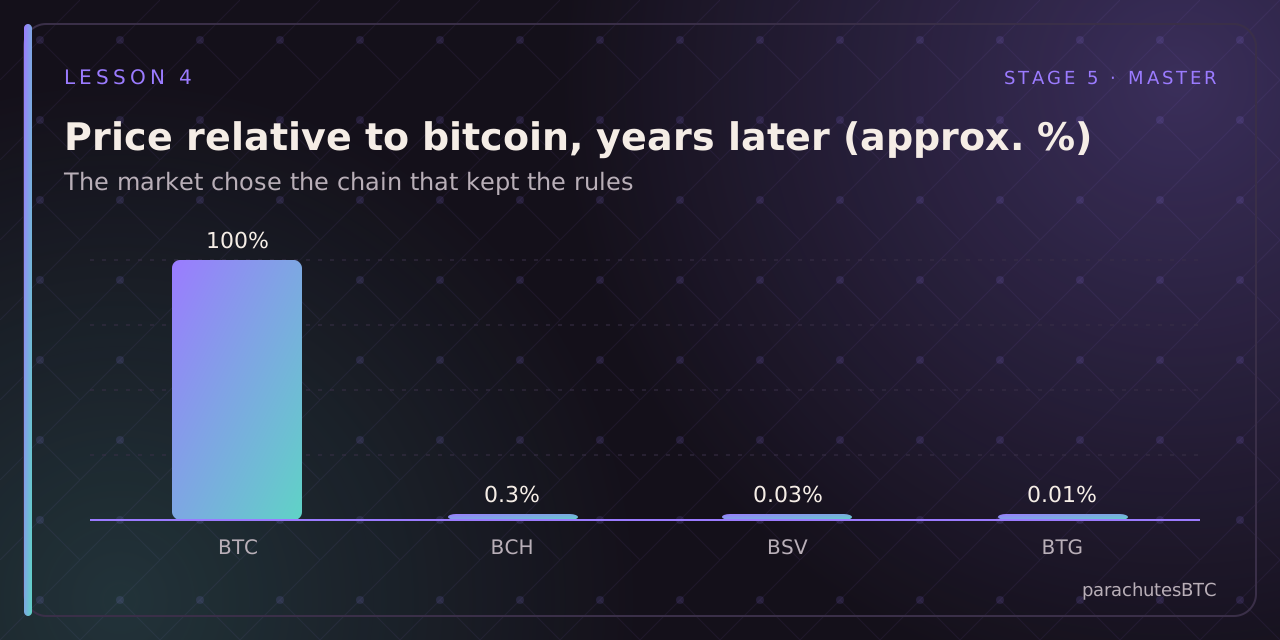
A hard fork copies the ledger: everyone who held bitcoin at the fork block held the new coin too. That made forks a tempting marketing device in 2017 and 2018. Dozens were announced. A few mattered briefly.
Bitcoin Cash (August 2017)
The big-block chain from the Blocksize War: 8 MB blocks, later 32 MB, no SegWit. Backed by large miners and a few prominent figures. It never approached bitcoin's hash rate, developer base or liquidity, and has traded at a small fraction of bitcoin's price since.
Bitcoin SV (November 2018)
A split from Bitcoin Cash led by Craig Wright, who claimed to be Satoshi (a claim UK courts rejected in 2024), with gigabyte-scale blocks. Delisted from major exchanges after its leadership's conduct; marginal today.
Bitcoin Gold, Diamond, Private and the rest
Mostly attempts to capture attention and the free coins. Several suffered 51% attacks because their hash rate was tiny. Most are effectively dead.
What the forks demonstrate
- Forking the code is easy; forking the network is not. Users, miners, exchanges, developers and liquidity stayed with the chain that kept the rules.
- Forks do not inflate bitcoin. The new coins are not bitcoin; the 21 million cap is untouched.
- Replay protection and other technical details matter when claiming forked coins; many people lost privacy or funds doing so carelessly.
- The economic majority chooses the name. Whichever chain the market values is "bitcoin", and so far it has always been the one that changed least.