
Bitcoin Core
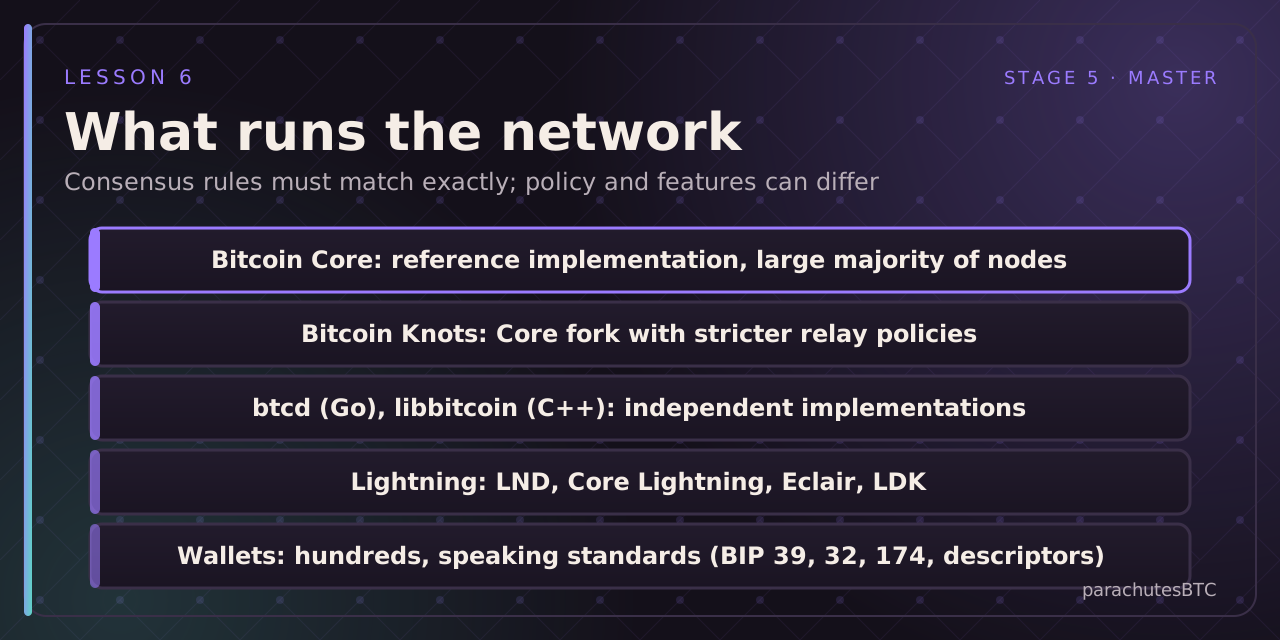
Descended from Satoshi's original code, developed by hundreds of contributors over the years, released roughly twice a year. Most nodes run it. It is a full node, a wallet, and a reference for what the consensus rules are, since the rules are defined by the code that the network runs rather than by a specification.
Bitcoin Knots
Maintained by Luke Dashjr, Knots tracks Core and adds options, notably stricter defaults about which transactions to relay (it rejects large data-carrying transactions). Its consensus rules are identical; a Knots node and a Core node agree on every block. Its node share grew sharply in 2025 as a protest over relay policy.
Independent implementations
btcd (Go) and libbitcoin (C++) re-implement the rules independently. The risk is subtle disagreement: if two implementations judge a block differently, the network splits. For that reason the community is cautious about "many implementations" as a goal; one well-reviewed implementation with alternatives for diversity is the current balance.
Policy versus consensus
Consensus rules decide what blocks are valid; every node must agree. Policy decides what a node relays or mines; nodes can differ. Minimum fee rates, OP_RETURN size, RBF signalling and standardness are policy. Most recent arguments have been about policy, which is why they are loud and non-fatal.
The rest
Lightning has four major implementations speaking the BOLT specs. Wallets number in the hundreds and interoperate through BIPs: seed words, derivation paths, PSBT, descriptors. The standards are the governance.