
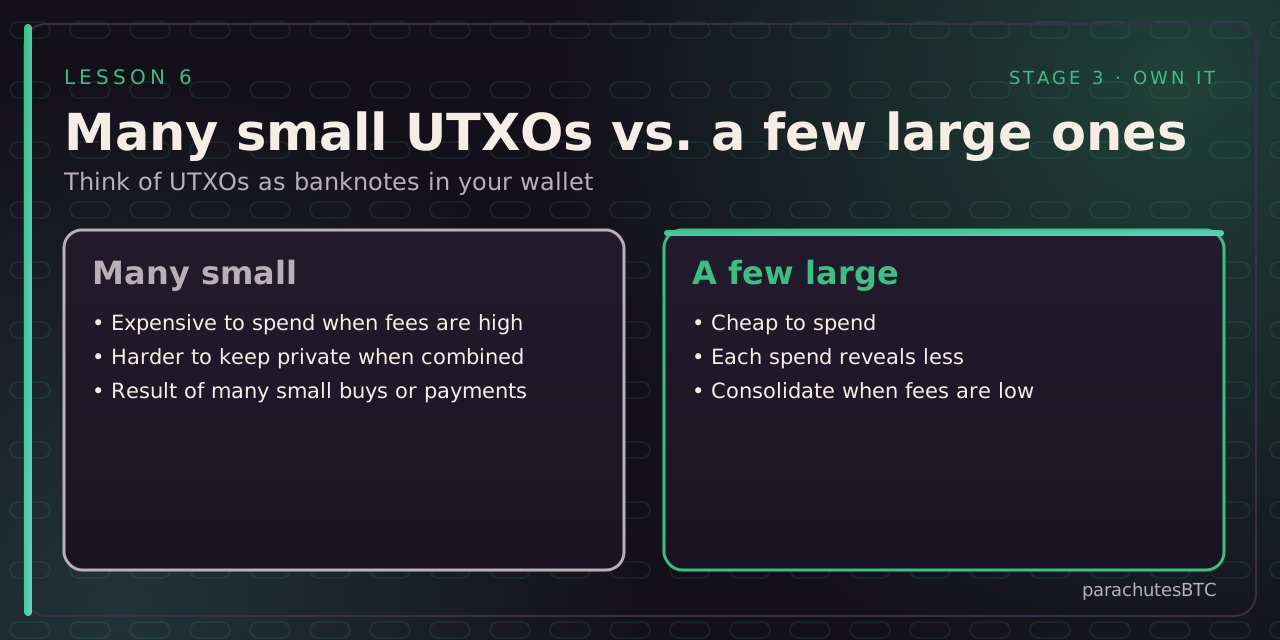
From the Under the hood course: your balance is a set of unspent outputs. Each has a size and a history. How you manage them affects your fees and your privacy.
Fees
A transaction's fee depends on its size in bytes, and each input adds bytes. Spending twenty small UTXOs costs far more than spending one large one. If you DCA weekly into self-custody for years, you accumulate hundreds of small outputs. When fees are high, spending them is painful; a few are "dust", worth less than the cost to move them.
Consolidation: when fees are low (a few sat/vB), send many small UTXOs to one new address of your own in a single transaction. You pay once, cheaply, to have one large output later.
Privacy
Every input in a transaction is assumed to belong to the same person (the common-input heuristic). Combine a coin bought on an exchange under your name with a coin you earned privately, and the two histories are now linked. Wallets with coin control let you choose which UTXOs to spend. Keep coins from different sources in separate accounts or wallets, and label them.
Habits
- Label every UTXO with where it came from.
- Consolidate in quiet fee periods, within one source.
- Do not merge KYC and non-KYC coins.
- Do not send dust; leave it or consolidate it when fees allow.
You have 30 UTXOs. A transaction with 30 inputs and 1 output is about 2,100 vbytes. At 3 sat/vB, what does consolidating cost in sats?