
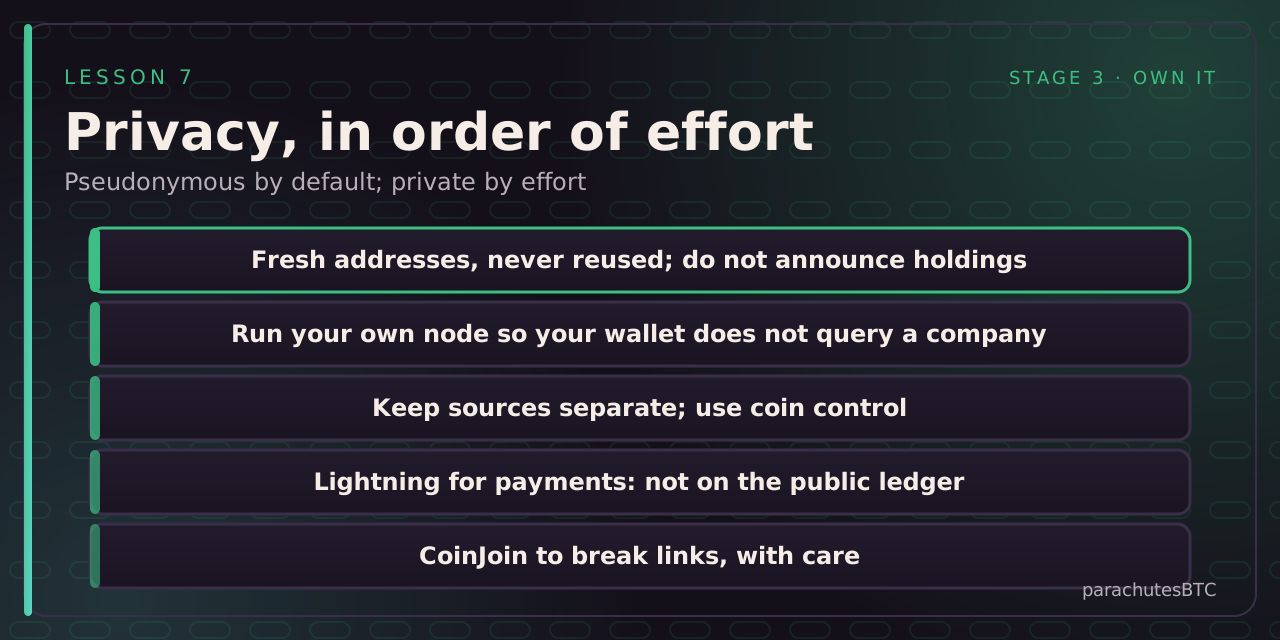
The ledger is public and permanent. Your privacy depends on how hard it is to connect addresses to you. Here is where the links come from and how to limit them.
Where identity leaks
- KYC purchases. The exchange knows which coins went to which address, and so do its regulators and anyone who breaches it.
- Address reuse and announcing holdings. Public addresses, donation pages and social media posts.
- Wallet servers. A light wallet asks a server about your addresses; that server knows them all. Running your own node removes this.
- Merging coins. The common-input heuristic links histories.
- Chain analysis. Firms cluster addresses with heuristics and sell the results.
What helps
- Fresh addresses for every receipt.
- Your own node behind your wallet, ideally over Tor. The Running a node course covers it.
- Coin control and separate accounts for separate sources.
- Lightning for payments. They are not written to the public ledger, and onion routing hides the path. Channel opens and closes are visible.
- CoinJoin. Several people build one transaction with equal outputs, so no one can say whose input became whose output. Available in a few wallets. Do not re-merge CoinJoin outputs with your other coins, and know your jurisdiction's rules.
Honest limits
Privacy is a set of habits, not a switch, and the tools carry legal and practical nuance that differs by country. Nothing here is legal guidance. Start with the easy items; they do most of the work.
CHECK YOURSELF
pick an answer for each question