
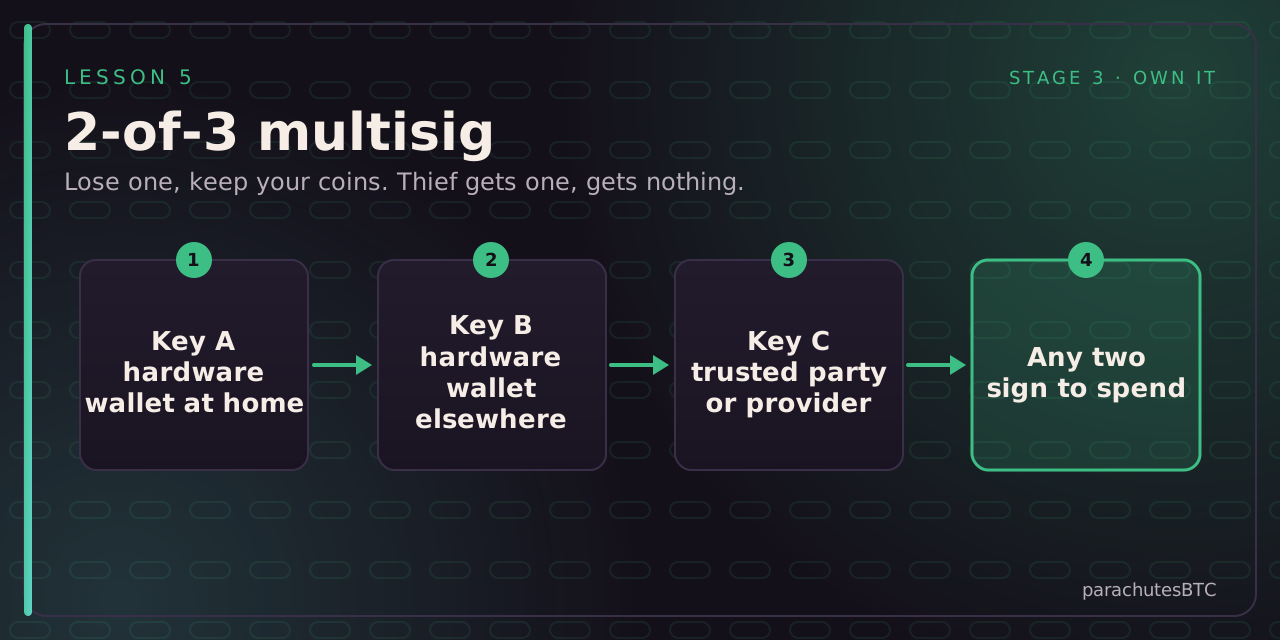
A multisig wallet locks coins to several keys and requires a threshold to spend: 2-of-3 is the common choice. The keys live on separate devices in separate places.
What it buys
- A lost or destroyed key does not lose the funds.
- A stolen key does not lose the funds.
- A single compromised device does not lose the funds.
- Spending requires deliberate action in more than one place, which also protects against your own panic.
What it costs
- Setup. Three devices, coordinating software, and a backup of the wallet descriptor (the xpubs and derivation paths), without which the keys alone cannot recover the wallet.
- Maintenance. Devices need checking; firmware ages; locations change.
- Inheritance. Heirs must understand a setup you found complex.
- Fees and privacy. Multisig transactions are larger and identifiable on-chain (Taproot improves this).
Collaborative custody
Companies offer multisig where you hold two keys and they hold one. They cannot move funds alone; they can co-sign if you lose a key or die, and they handle the software. You trade a little privacy and a fee for help with recovery. For many people with serious amounts it is the practical middle.
When
Multisig is for savings large enough that a single hardware wallet feels like too much risk, and for people willing to maintain it. For smaller amounts a single hardware wallet with a good metal backup is simpler and safer in practice, because most losses are user error, and multisig gives you more to get wrong.