
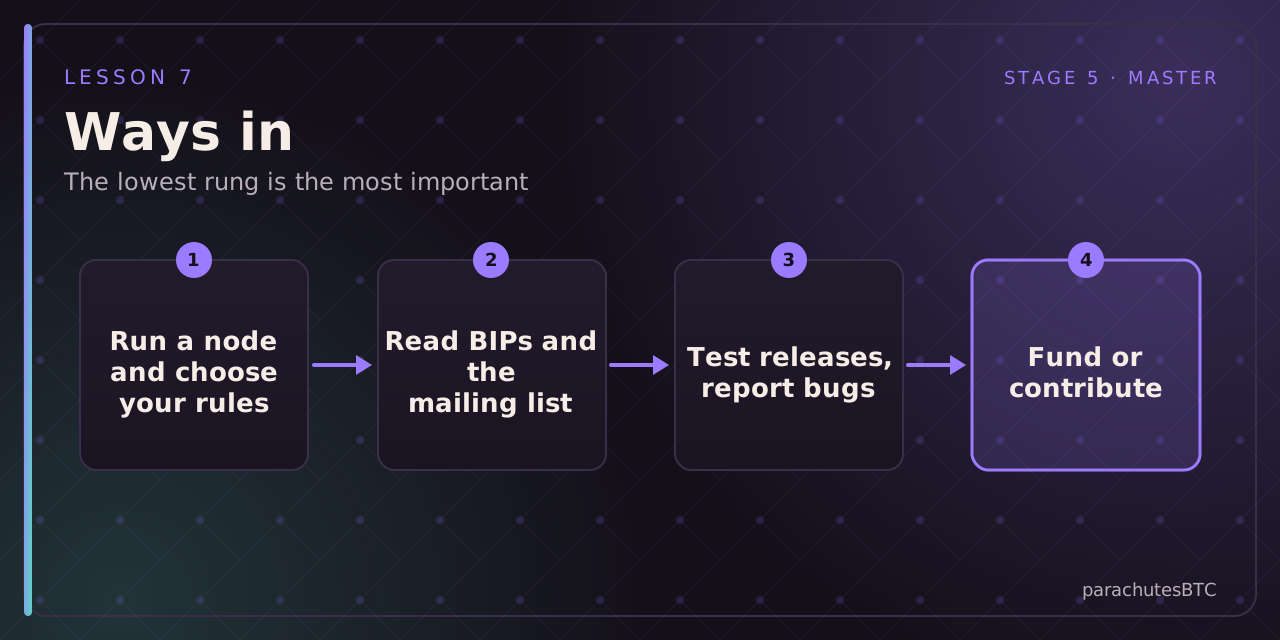
Bitcoin's governance only works if the people who hold bitcoin actually exercise their part of it. Here is how.
Run a node
The single most important act. Your node enforces the rules you chose. If a contested change comes, the nodes decide, and a node you run is your say. The Running a node course is next.
Read
The bitcoin-dev mailing list (now hosted on Google Groups), the BIPs repository, and Bitcoin Optech's weekly newsletter, which translates developer discussion into plain English. You do not need to understand everything; you need to know what is proposed and what the objections are before you upgrade.
Test
Releases have candidate versions. Running one on a spare machine and reporting problems is real contribution. So is testing wallets against new features on signet.
Fund
Independent development is funded by grants: Brink, OpenSats, the Human Rights Foundation and company programmes. Donating, or lobbying your exchange to fund developers, keeps the people writing the code answerable to no single employer.
Contribute
Code review is the bottleneck in Core; careful reviewers are valued more than new features. Documentation, translations and education count too. The Chaincode seminars and the Bitcoin Core PR Review Club are open doors.
Hold your position
When a change is proposed, the question is never "is this clever?" but "does this keep Bitcoin the thing I hold it for?" The 2017 precedent exists because ordinary holders ran nodes and said no. That option is always there.