
The disagreement
As blocks filled in 2015, one camp argued the 1 MB limit should rise so fees stayed low and bitcoin could be everyday cash: "big blockers". The other argued that larger blocks would make running a node expensive, concentrating validation in data centres and companies, and that scaling belonged in layers: "small blockers". Underneath was a deeper question: is Bitcoin a payment network run by its businesses, or a settlement layer verified by its users?
The campaigns
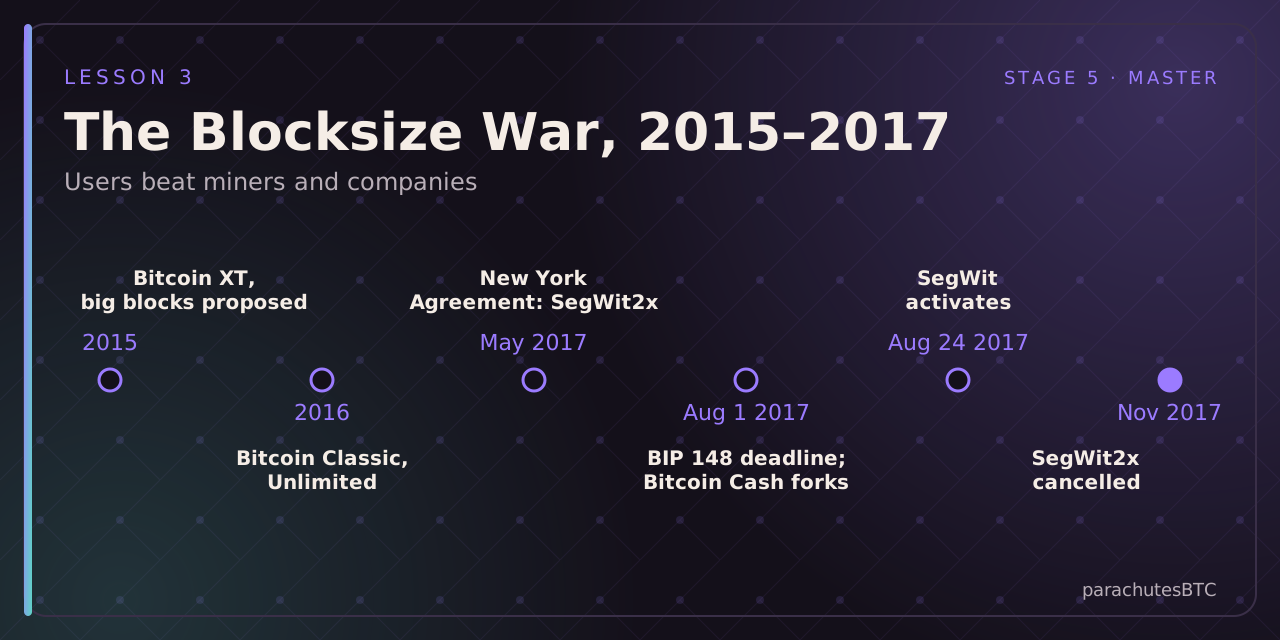
- Bitcoin XT (2015), Classic and Unlimited (2016): alternative implementations with bigger blocks, each backed by prominent developers, miners and companies. None reached the adoption needed.
- SegWit (2016): the Core developers' proposal, a soft fork that fixed malleability and modestly raised capacity. Big-block miners refused to signal for it for months, using BIP 9's threshold as a veto.
- The New York Agreement (May 2017): about 58 companies and most of the hash rate agreed to SegWit2x: activate SegWit, then hard-fork to 2 MB blocks months later. Negotiated in a closed meeting. No Core developers attended.
The users' move
BIP 148, the user-activated soft fork: from 1 August 2017, participating nodes would reject any block that did not signal for SegWit. It threatened to split the chain unless miners complied. A grassroots campaign spread it. Facing the prospect of mining a chain the economic majority would not value, miners began signalling in late July. SegWit locked in and activated on 24 August.
The split and the collapse
On 1 August, big blockers forked Bitcoin Cash with 8 MB blocks. It traded at a fraction of bitcoin's price and still does. In November, the SegWit2x hard fork was cancelled for lack of support days before its block height.
What it settled
Hash power and corporate consensus cannot change Bitcoin's rules against the will of the people who run nodes and hold coins. The chain stayed small-block, Lightning became possible, and a precedent was set that every later proposal is measured against. Jonathan Bier's book The Blocksize War is the detailed history.