
The idea
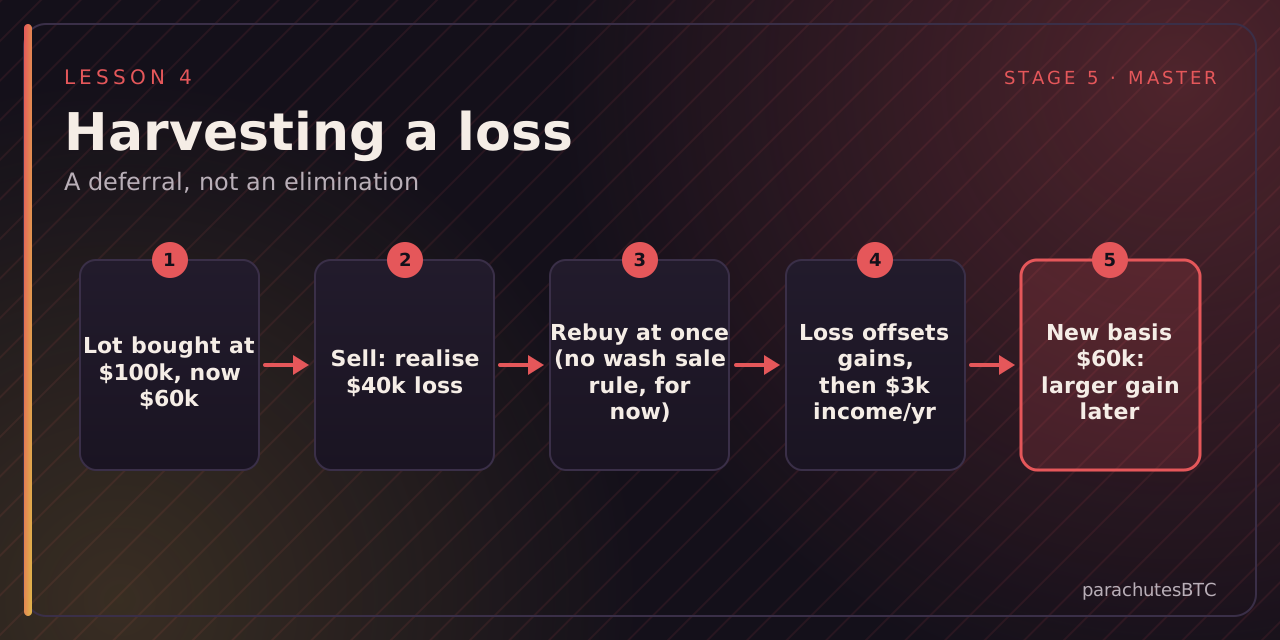
If a lot is worth less than you paid, selling it realises a capital loss. Losses offset capital gains dollar for dollar, then up to $3,000 a year of ordinary income, with the rest carried forward indefinitely. If you buy back immediately, you keep your exposure and have banked the loss.
The wash-sale question
For stocks, the wash-sale rule disallows a loss if you buy the same security within 30 days before or after. The rule applies to securities, and the IRS treats bitcoin as property, not a security, so as of 2026 it does not apply to bitcoin. Congress has proposed closing this repeatedly. Check the current law before relying on it, and expect it to change.
What it does not do
- It does not eliminate tax; it defers it. Your new basis is lower, so the future gain is larger. The benefit is time, and the chance that a long-term rate applies later.
- It costs fees and spread on the round trip.
- It creates a short-term holding period on the rebought lot, which matters if you sell within a year.
- It adds records to keep.
When people use it
In drawdowns, against gains realised elsewhere in the same year, and at year end. The DCA calculator shows how often lots have been underwater historically, which is more often than people remember.
This year you realised $12,000 of long-term gains on stock and harvested a $20,000 bitcoin loss. After offsetting the gains and the $3,000 income allowance, how much loss carries forward to next year, in dollars?