
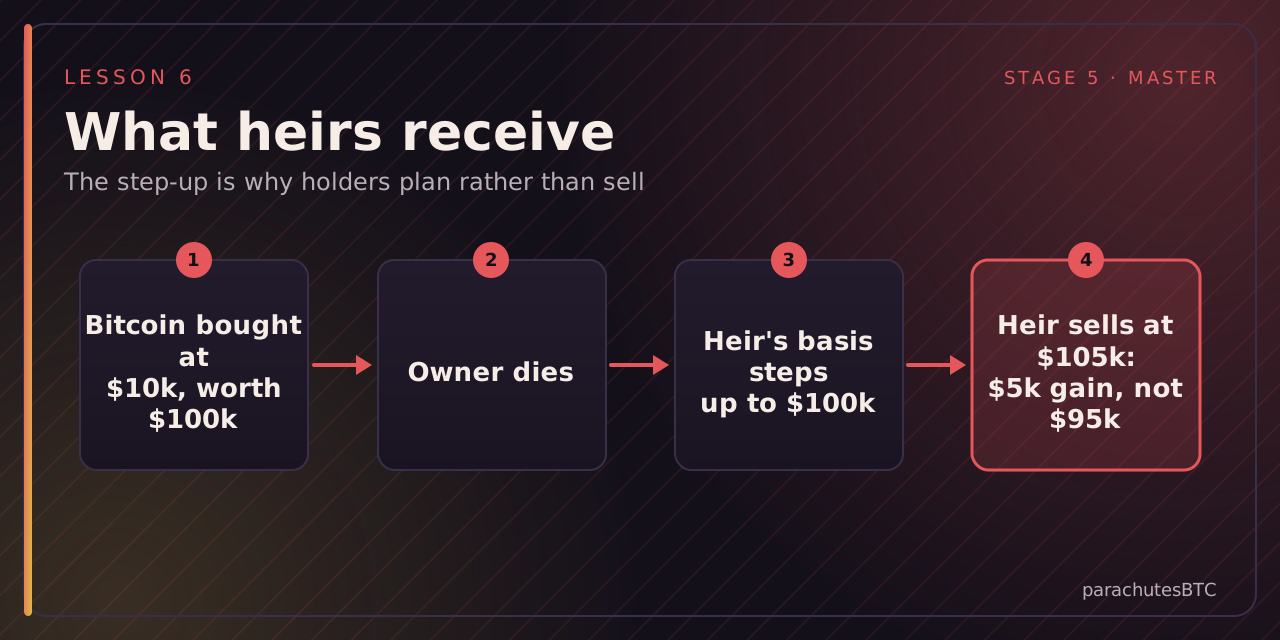
The step-up
When you inherit property in the US, your cost basis becomes its fair market value on the date of death. A bitcoin bought for $10,000 and worth $100,000 at death passes to the heir with a $100,000 basis. If they sell at $105,000, the gain is $5,000; the $90,000 of appreciation during the original owner's life is never taxed as capital gain. This is one of the strongest tax planning facts in the US system, and it is why long-term holders talk about never selling.
Estate tax
Federal estate tax applies only to estates above a large exemption (over $13 million per person in 2025, scheduled to change). A few states have their own, lower thresholds. Bitcoin is counted at its value on the date of death, which for a volatile asset can be a lucky or unlucky day; an alternate valuation date six months later is available.
The practical trap
None of this matters if the heirs cannot access the coins. Tax law assumes the asset is reachable; bitcoin is reachable only with the keys. The estate also needs to prove the holdings and their value, which means records: addresses or xpubs, acquisition history, and the plan that lets the executor or trustee act.
Gifts during life
Giving bitcoin while alive transfers your basis to the recipient (carryover), not a stepped-up one. Gifts above the annual exclusion count against the lifetime exemption. For appreciated assets, dying with them is usually better tax-wise than gifting them; that is an uncomfortable sentence and a real planning input.
Beyond the US
Other countries vary completely: some tax inheritance heavily, some have no capital gains tax at all. Nothing here transfers across borders.