
The arithmetic
Gain or loss = proceeds − cost basis. Basis is what you paid including fees. Proceeds are what you received, in dollars, at the time.
Holding period
- Short-term: held one year or less. Taxed as ordinary income, 10 to 37% federal in 2025, plus state.
- Long-term: held more than one year. Taxed at 0, 15 or 20% federal depending on income, plus the 3.8% net investment income tax for higher earners, plus state.
The difference between day 365 and day 366 can be large. Many holders track lots specifically to sell the long-term ones.
Lot methods
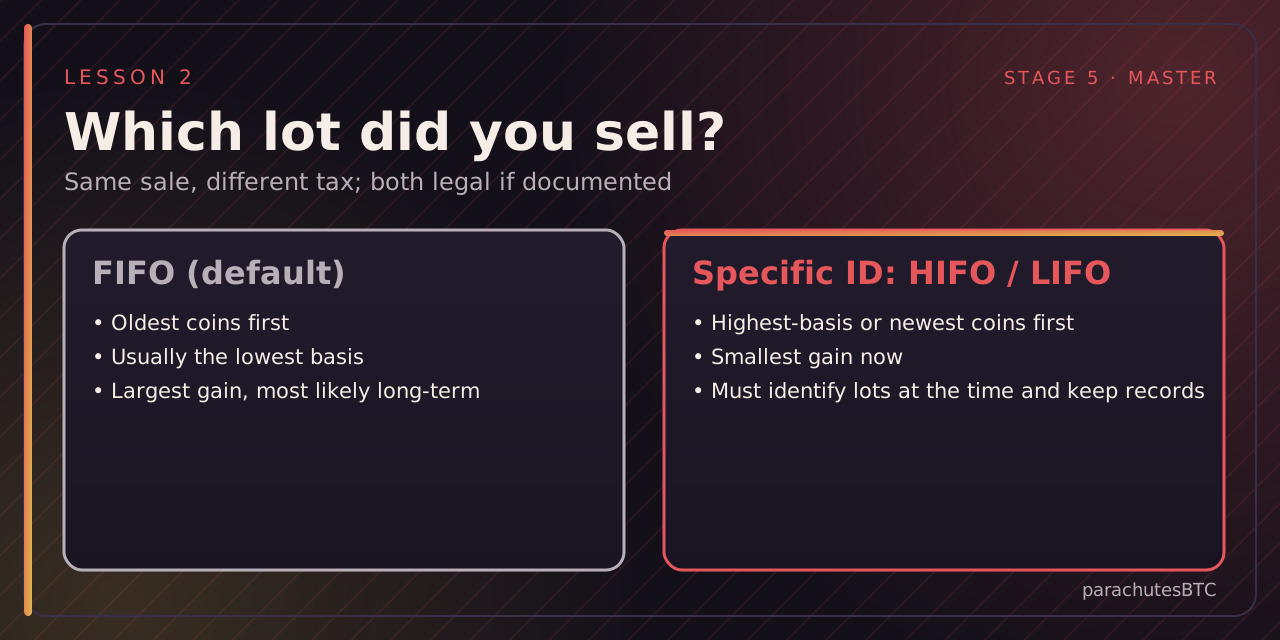
You hold bitcoin bought at many prices. When you sell part, which part did you sell?
- FIFO (first in, first out): the oldest lot. The default if you do nothing. From 2026, brokers report FIFO unless you tell them otherwise.
- Specific identification: you choose the lot, which lets you use HIFO (highest cost first, minimising gain) or LIFO (newest first). The IRS allows it if you identify the units at the time of sale and keep records, and since 2025 this must be done wallet-by-wallet, not across all your holdings as one pool.
- Average cost is not available for bitcoin in the US.
Worked example
You bought 1 BTC at $30,000 (2022), 1 at $60,000 (2024) and 1 at $90,000 (2025). You sell 1 BTC in 2026 for $100,000.
- FIFO: gain $70,000, long-term.
- HIFO: gain $10,000, short-term if the $90,000 lot is under a year old.
Both are correct. HIFO defers tax; FIFO may get the lower long-term rate. The right answer depends on your bracket and plans.
MINI CHALLENGEPick the lot
Using the example above, you instead sell 1 BTC for $75,000. What is the gain under HIFO, in dollars? (Highest-basis lot first.)
dollars
$75,000 minus the $90,000 lot.
A $15,000 loss, which can offset other gains. Same sale, FIFO would show a $45,000 gain.
CHECK YOURSELF
pick an answer for each question