
The framework
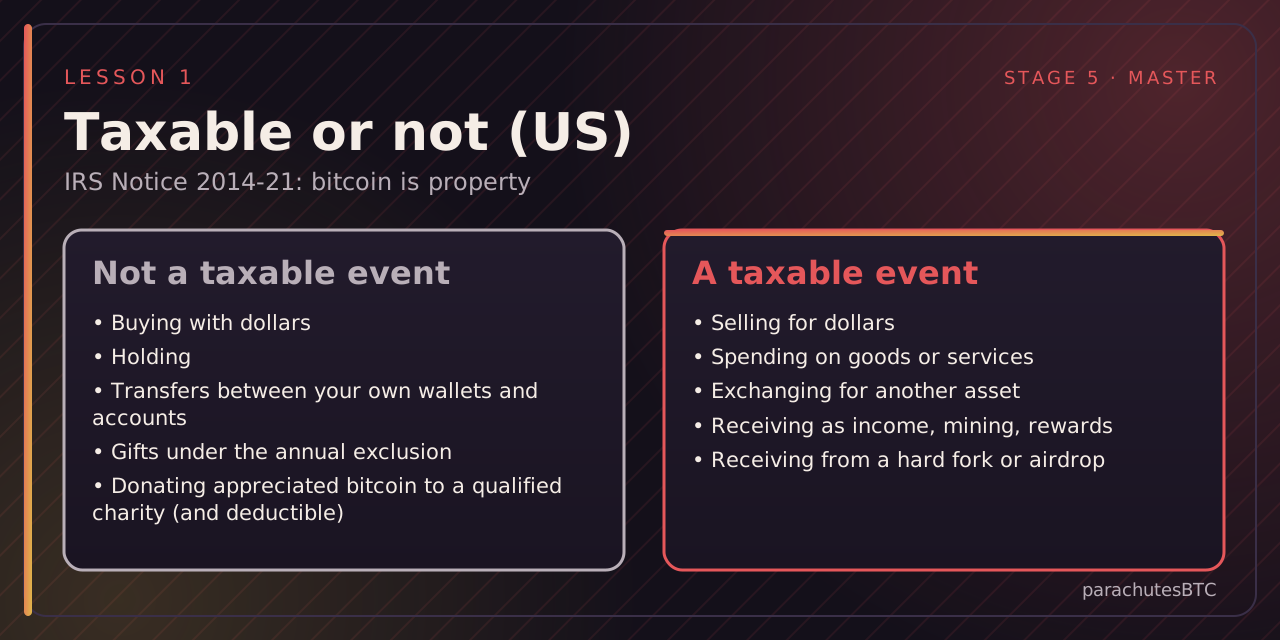
IRS Notice 2014-21 classified virtual currency as property, not currency. Everything follows from that. Property has a cost basis; disposing of it realises a gain or loss; receiving it as payment is income at fair market value.
Non-events
- Buying bitcoin with dollars.
- Holding, for any length of time.
- Moving between wallets, exchanges or accounts you control. (Keep records: brokers cannot tell a transfer from a sale.)
- Gifting below the annual exclusion, about $19,000 per recipient per year in 2025; above it, a gift tax return (Form 709) but usually no tax, counting against a large lifetime exemption.
- Donating appreciated bitcoin held over a year to a qualified charity: no gain realised and a deduction at fair market value, with Form 8283 above $500.
Events
- Selling for dollars.
- Spending. Buying a coffee with bitcoin is a sale of that bitcoin at the coffee's price. Every Lightning payment too. Spending wallets that track lots make this tolerable; the rule is still the rule.
- Exchanging for another asset, including stablecoins.
- Receiving as income: wages, mining rewards, staking-like rewards, interest, referral bonuses. Ordinary income at the value when received; that value becomes the basis.
- Forks and airdrops: ordinary income when you have dominion over the new coins.
Lost and stolen
Under the 2017 tax law, personal theft and casualty losses are generally not deductible through 2025. A lost seed phrase is, for tax purposes, usually just a loss you cannot claim. Rules may change; ask.
CHECK YOURSELF
pick an answer for each question