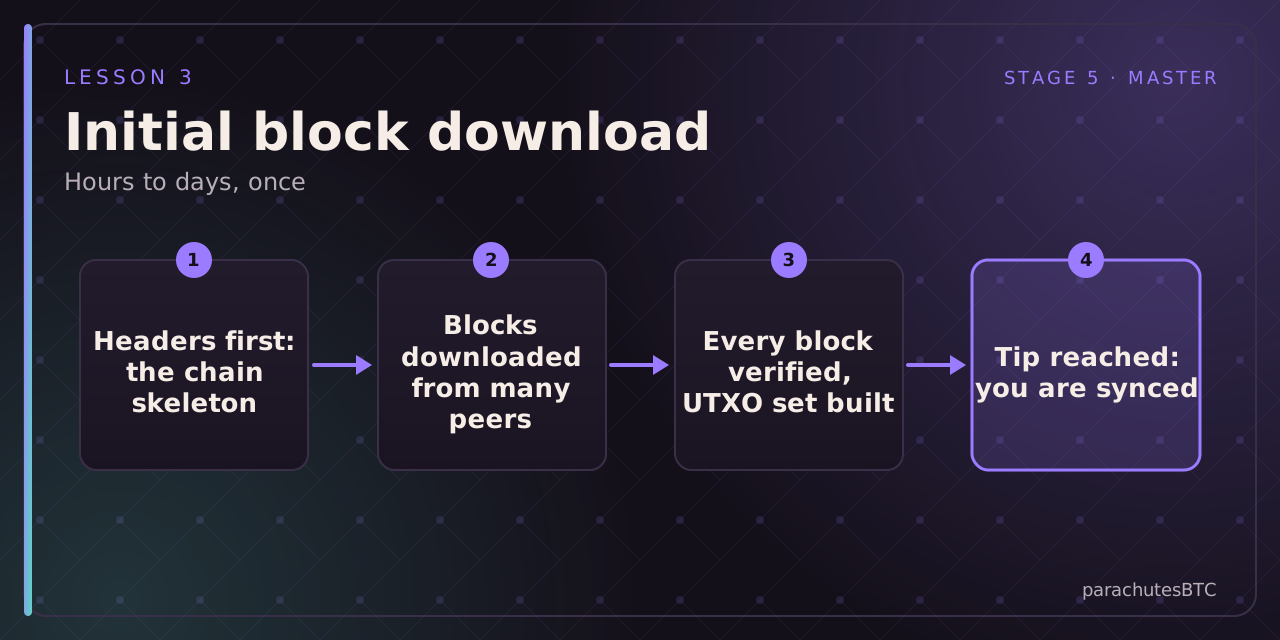
The first sync downloads and verifies seventeen years of blocks. It takes hours to days, and when it finishes your node has independently rebuilt the entire state of Bitcoin.
Before you start: A node installed and connected to the internet.
IN THIS LESSON · 3 OF 5
BY THE END YOU WILL BE ABLE TO ANSWER
What does the node hold when the initial sync completes?
What does assumevalid skip?
At block 840,000 (the April 2024 halving), roughly how many bitcoin had been issued, in millions? Era totals: 10.5 + 5.25 + 2.625 + 1.3125.
Then prove it: a 2-question quiz · a challenge. The lesson marks itself complete at 100%.
What is happening
Your node first downloads all block headers from peers, which gives it the chain's shape and total work. Then it fetches blocks in parallel from several peers and verifies each one in order: proof of work, every transaction, every signature (for recent blocks), building the UTXO set as it goes. At the end it holds the complete current state of Bitcoin, computed entirely by itself.
Steps
Check your work
Run getblockchaininfo (or look at the dashboard). The block count should match the network height and verificationprogress should be essentially 1. Run gettxoutsetinfo to have your node report the total supply it computed. That number is 21 million being verified by your own machine.
MINI CHALLENGEVerify the supply
At block 840,000 (the April 2024 halving), roughly how many bitcoin had been issued, in millions? Era totals: 10.5 + 5.25 + 2.625 + 1.3125.
million BTC
Add the four completed eras.
19,687,500 BTC. Your node computes this exactly from the UTXO set.
CHECK YOURSELF
pick an answer for each question
Progress is saved in this browser only.
RECAP · THE MAIN POINTS
01The complete verified current state: every unspent outputRebuilt from genesis, by your machine.
02Signature checks for blocks before a known recent block; structure and chain are still verifiedA speed-up, not a trust shortcut for anything but signatures in deep history.