
The halving is automatic. At block heights that are multiples of 210,000, nodes simply expect half the previous subsidy. Nothing is announced; the code has always known the dates in blocks.
The record
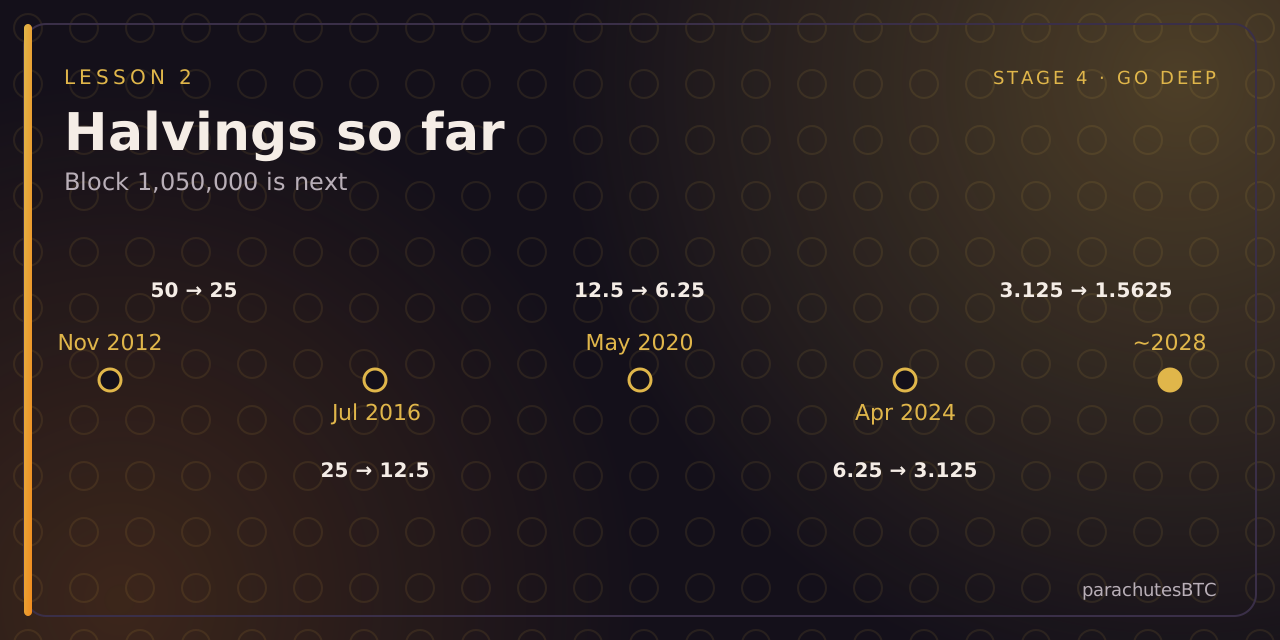
- 28 November 2012, block 210,000: 50 to 25 BTC.
- 9 July 2016, block 420,000: 25 to 12.5.
- 11 May 2020, block 630,000: 12.5 to 6.25.
- 19/20 April 2024, block 840,000: 6.25 to 3.125.
- Next: block 1,050,000, expected around April 2028, to 1.5625.
Issuance in practice
At about 144 blocks a day, 3.125 BTC per block is roughly 450 new bitcoin a day, about 164,000 a year, under 1% of supply. After the next halving: about 225 a day. Bitcoin's "inflation rate" fell below the Federal Reserve's 2% target in 2020 and below gold's annual supply growth in 2024.
Effect on miners
Subsidy income halves overnight while costs do not. Inefficient miners shut down, hash rate dips, difficulty adjusts down, and the survivors earn the same subsidy with less competition. Every halving so far has been followed within months by a new hash rate high.
Effect on price
None, by rule. The price rose after each of the first three halvings, which is three data points and a popular story; the Markets and price course takes it apart. The halving is a supply fact; what the market does with it is not written anywhere.