
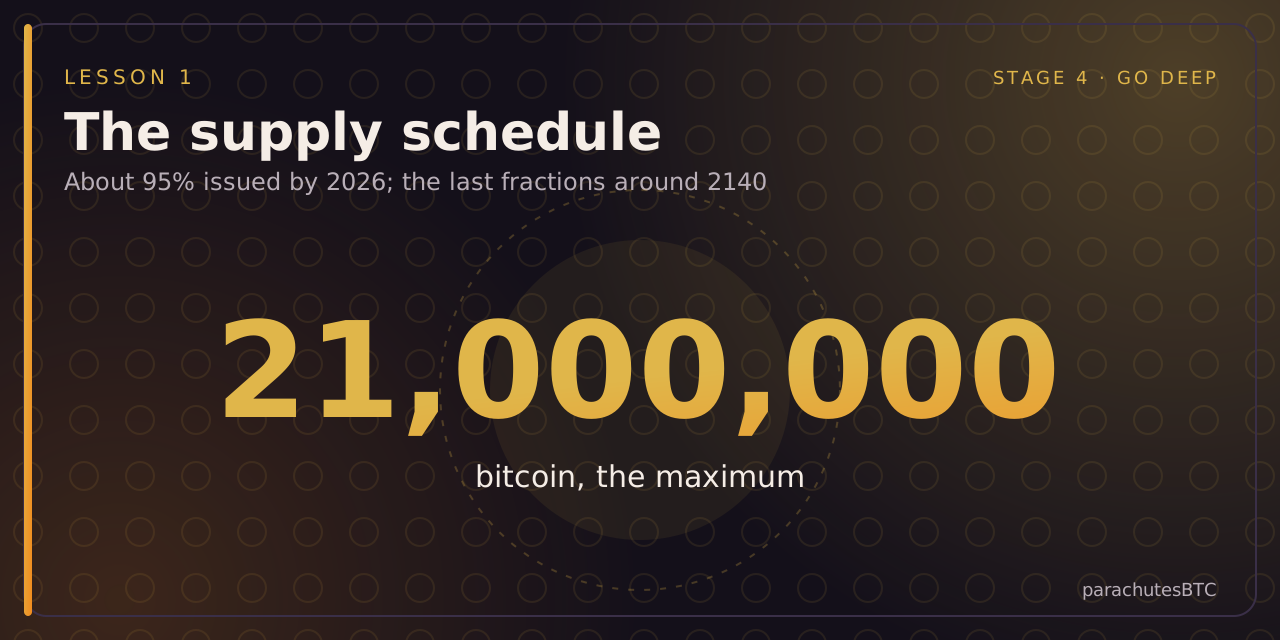
Bitcoin's rules cap the total at 21 million. New coins are created only as the block subsidy paid to miners, and that subsidy follows a schedule fixed in the code since 2009.
The arithmetic
Each era lasts 210,000 blocks. The subsidy starts at 50 BTC and halves each era:
| Era | Blocks | Subsidy | Issued in era | Cumulative |
|---|---|---|---|---|
| 1 | 0–209,999 | 50 | 10,500,000 | 10,500,000 |
| 2 | 210,000–419,999 | 25 | 5,250,000 | 15,750,000 |
| 3 | 420,000–629,999 | 12.5 | 2,625,000 | 18,375,000 |
| 4 | 630,000–839,999 | 6.25 | 1,312,500 | 19,687,500 |
| 5 | 840,000–1,049,999 | 3.125 | 656,250 | 20,343,750 |
The series sums toward 21 million and never reaches it. Because the subsidy is an integer number of satoshis and halving rounds down, the final total is 20,999,999.9769 BTC. The last satoshi is issued around the year 2140, at the 33rd halving.
Where we are
As of 2026, over 19.9 million bitcoin have been issued, about 95% of the total. Annual issuance is below 1% of supply, lower than gold's. Check the live figures on the Bitcoin Charts dashboard.
Why anyone can trust it
The schedule is not a promise. Every node checks that each block's coinbase pays at most the subsidy for that height plus fees. A block paying more is invalid everywhere.
Era 6 (blocks 1,050,000 to 1,259,999) pays 1.5625 BTC per block. How many BTC are issued in that era?