
The supply schedule is written in blocks. For it to be steady in time, blocks must arrive at a steady rate however much hardware is mining. That is the difficulty adjustment's job.
The rule
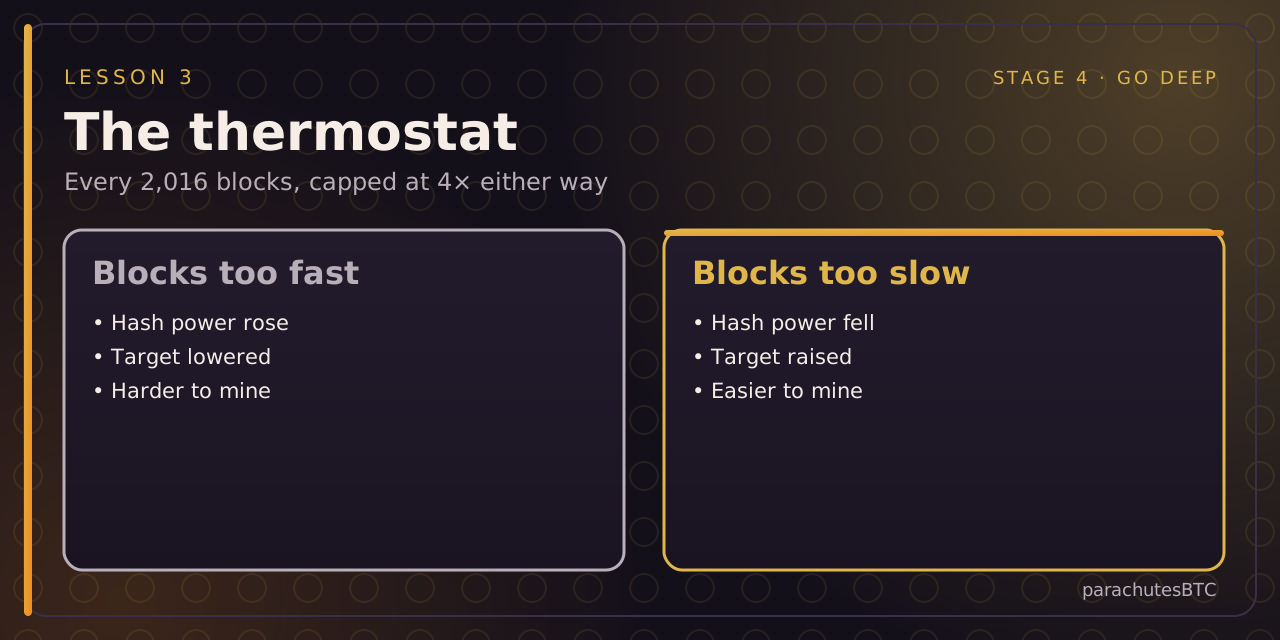
Every 2,016 blocks, nodes compare the actual time taken with the expected 20,160 minutes and scale the target by the ratio, capped at a factor of four per adjustment. Fast blocks mean a lower target (harder); slow blocks mean a higher one (easier).
What it means for monetary policy
- Adding hash power does not create more bitcoin. It only raises the difficulty for everyone. Supply is immune to effort.
- Losing hash power does not stop issuance. After China's 2021 mining ban, roughly half the network went offline; blocks slowed for weeks, then difficulty fell about 28% in one adjustment, the largest ever, and the schedule resumed.
- The cost of producing a bitcoin floats with competition, but the number produced does not.
What you can watch
Difficulty, hash rate and the estimated next adjustment are on the Bitcoin Charts dashboard under Mining.
CHECK YOURSELF
pick an answer for each question