
The FUD course gave the short answer. This lesson is the long one.
The numbers
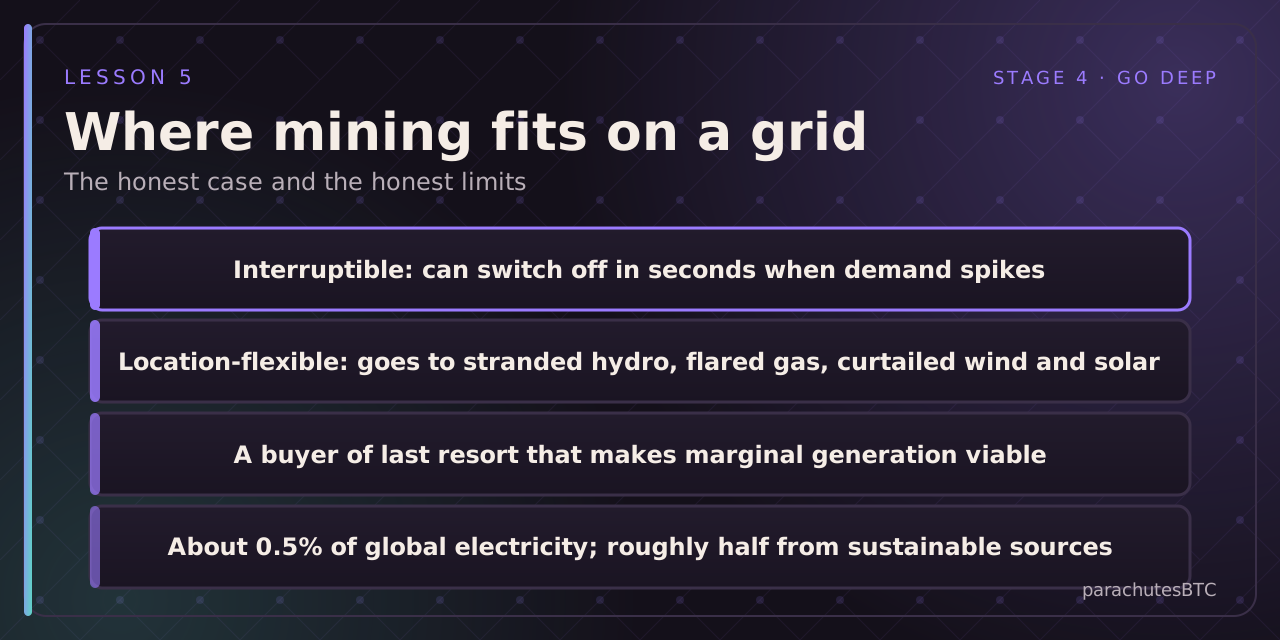
Cambridge's index estimates Bitcoin at roughly 138 TWh a year, about 0.5% of global electricity. Industry and academic surveys put the sustainable share (renewables plus nuclear) around half, higher than most national grids. Emissions estimates vary with assumptions about fuel mix and are falling as miners move to cheaper, often renewable, power.
Why mining is unusual
- Interruptible. A mine can shut off in seconds and lose only the bitcoin it would have earned. Grid operators pay for that: in Texas, miners curtail during heatwaves and are compensated, acting as a large, fast demand-response resource.
- Location-flexible. Mining needs power and an internet connection, nothing else. It goes to power that cannot reach consumers: hydro in remote regions, gas that would otherwise be flared at oil wells, wind and solar that would be curtailed at midday.
- Buyer of last resort. By paying for otherwise-wasted power, mining can make marginal renewable projects financeable, and it finances grid build-out in places like rural Africa (the Gridless project) where mining revenue funds the plant that then serves the village.
The honest limits
Mining still consumes real energy that could in principle go elsewhere, and some mining runs on coal. "Per transaction" energy figures are misleading (mining secures the ledger, not individual payments), but the total is not nothing. Whether the security of a global, neutral money is worth half a percent of the world's electricity is a judgment, not a calculation. Bitcoiners make it one way; critics the other.
What it cannot do
Mining cannot be repurposed to "useful work" like folding proteins without breaking its security property, which requires the work to be cheap to verify and useless except as proof. The energy is the point.