
The strongest version
Bitcoin consumes as much electricity as a mid-sized country to process a handful of transactions per second. That is wasteful, and in a warming world, indefensible.
What the energy does
Proof of work ties the cost of rewriting history to real resources. Every joule spent on hashing is a joule an attacker would have to out-spend. Remove the energy and you remove the security; that is what proof-of-stake systems do, and the trade is control by whoever holds the most tokens.
The numbers
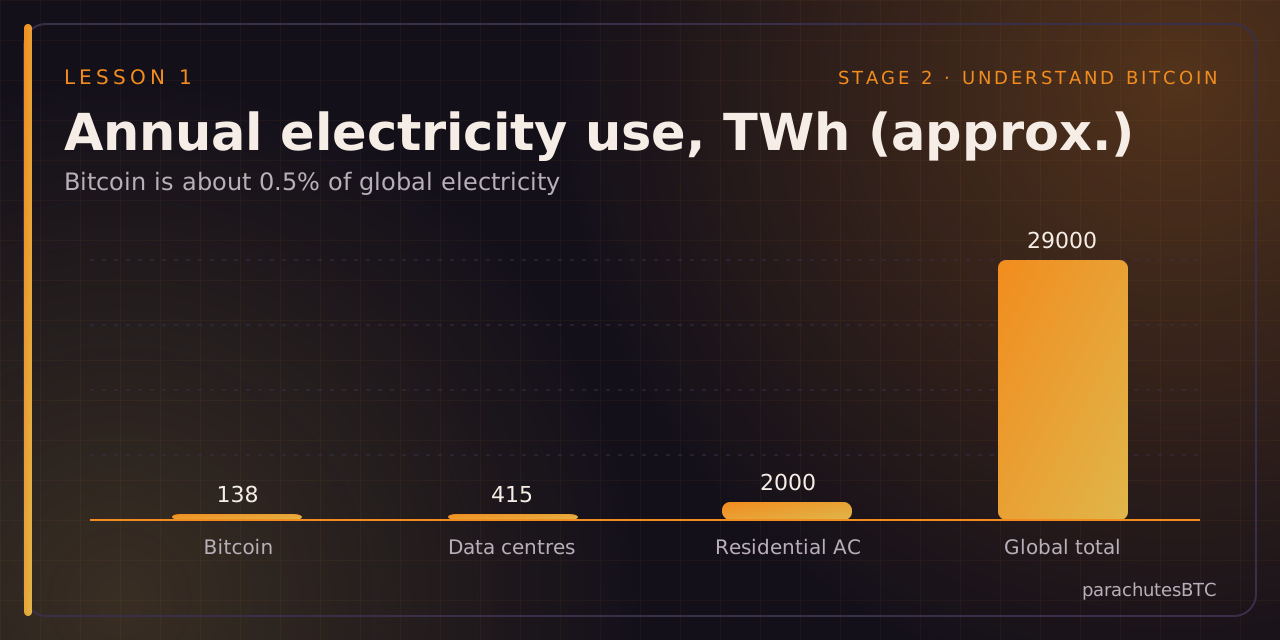
- Cambridge estimates Bitcoin at roughly 138 TWh a year, about 0.5% of global electricity, less than data centres and far less than residential air conditioning.
- "Energy per transaction" is a misleading metric: mining secures the whole ledger, not individual payments, and Lightning carries many payments per on-chain transaction.
- Miners go where power is cheapest, which means stranded hydro, flared gas and curtailed wind and solar. Industry surveys put the sustainable share around half, higher than most national grids.
- Mining is an interruptible load: it can switch off in seconds when the grid needs power, which grid operators in Texas pay for.
What remains true
Bitcoin uses real energy, and it will keep doing so as long as it is worth securing. Whether that is "worth it" is a judgment about the value of neutral, unconfiscatable money. The energy is not a bug to be fixed; it is the cost of the thing.
CHECK YOURSELF
pick an answer for each question