
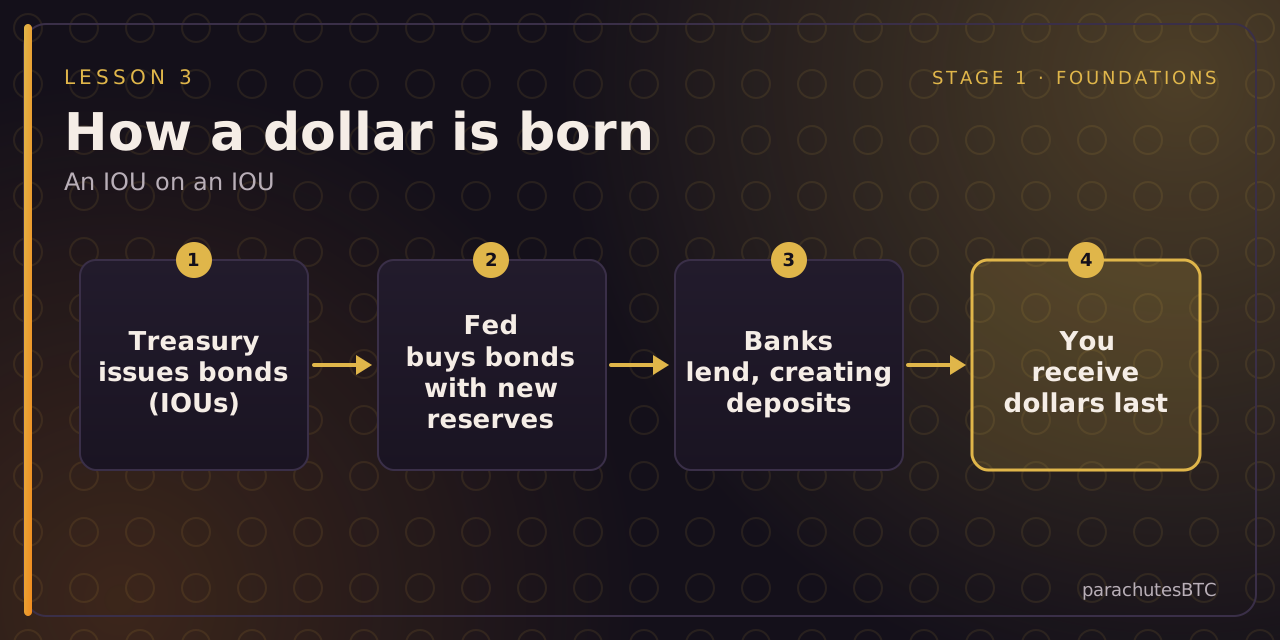
Fiat is Latin for "let it be done". Fiat money is money because the government says so and demands taxes in it. It is not redeemable for gold or anything else. Every major currency has been fiat since 1971.
Who makes it
Three parties create dollars, and none of them is you:
- The Treasury borrows by selling bonds, which are IOUs.
- The Federal Reserve, the US central bank founded in 1913, can buy those bonds with reserves it creates by keystroke. This is what "quantitative easing" means.
- Commercial banks create deposits when they lend. A loan is new money; it did not come out of anyone's savings. Under fractional reserve banking, banks keep only a fraction of deposits on hand; since 2020 the US reserve requirement is zero.
More than 80% of the dollars in existence today were created after the year 2000. There is no upper limit.
Why governments like it
Fiat gives the state a steering wheel: it can cut interest rates in a recession, fund a war or a bailout without raising taxes, and act as lender of last resort to banks. The cost is that the steering wheel is also a printing press, and every dollar created dilutes every dollar saved.
Next
What happens to prices when the supply of money keeps growing? Lesson 4 is on inflation, and lesson 5 on who wins and who loses from it.