
Inflation is a general rise in prices, which is the same as money buying less. The older definition, from the Austrian economists, is an increase in the supply of money; rising prices are the effect. Milton Friedman put it plainly: "Inflation is always and everywhere a monetary phenomenon."
How it is measured
Governments publish a Consumer Price Index (CPI): the average price of a basket of goods. The Federal Reserve prefers a measure called PCE and aims for 2% a year. Both leave out or adjust things in ways that tend to understate what households experience, which is why your rent feels nothing like 2%.
What it does over time
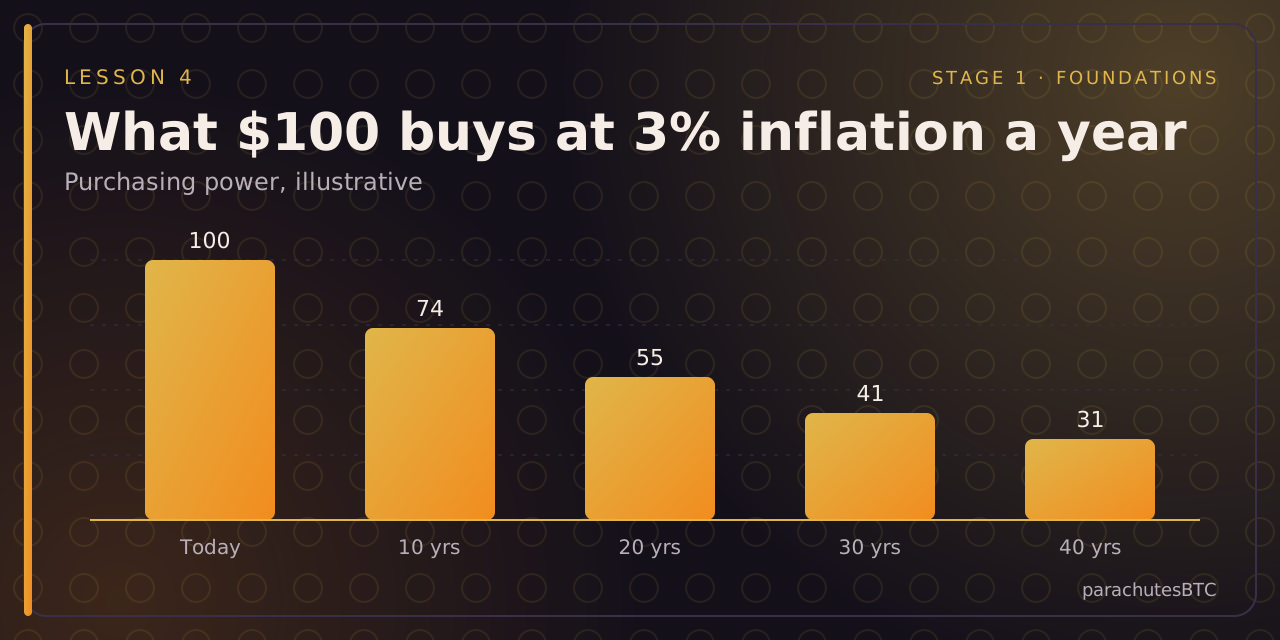
The chart is illustrative, not a forecast. At 3% a year, 100 dollars of purchasing power becomes about 74 after ten years, 55 after twenty and 41 after thirty. At the official "target" of 2%, you still lose half over 35 years. Since 2000 the dollar has lost more than half its purchasing power; since 1971, around 87%.
Winners and losers
Inflation is a transfer. Borrowers with fixed-rate debt repay with cheaper money. Owners of scarce assets (houses, stocks, gold, bitcoin) see their prices rise with the money supply. People paid in wages and people holding cash savings pay for it. The next lesson explains why the transfer runs in that direction.
At 3% inflation a year, roughly what is 100 dollars of purchasing power worth after 20 years? (The formula is 100 ÷ 1.03²⁰.)
Next
Why do asset owners win and wage earners lose? The answer has a name: the Cantillon Effect.