
What Lightning hides
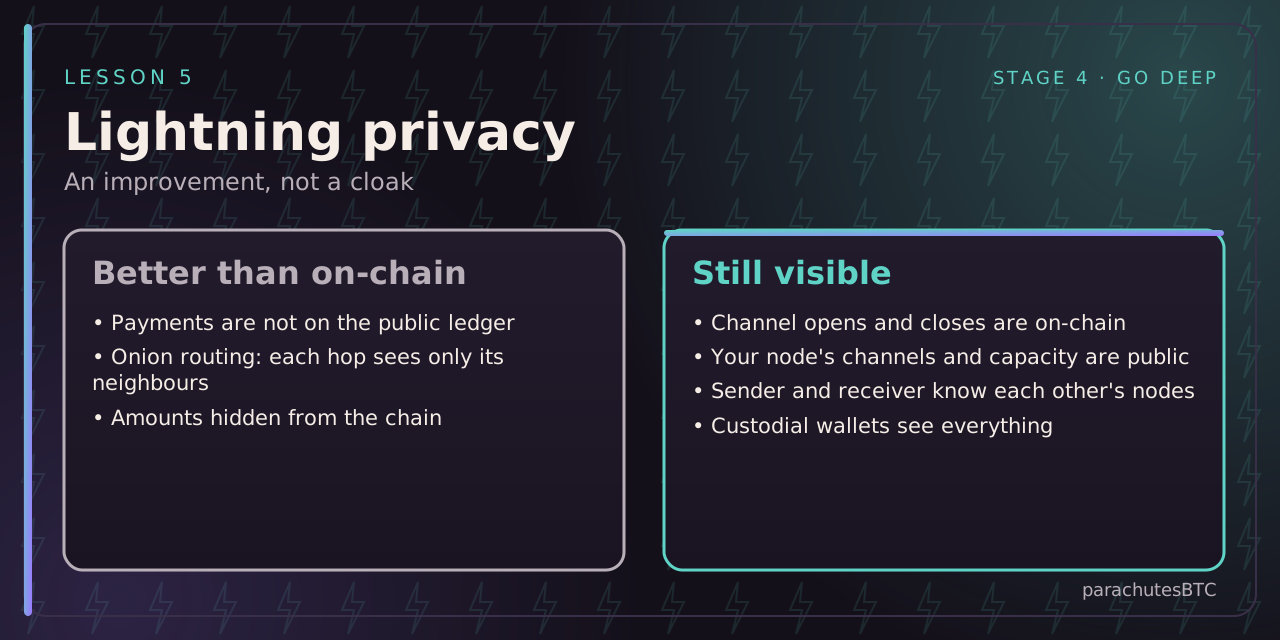
Payments never touch the public ledger. Routes use onion routing: each hop decrypts one layer and learns only the previous and next hop, not the sender or final receiver. Amounts are known only to the parties on the path. Compared with an on-chain payment, which publishes sender, receiver and amount forever, this is a large improvement.
What it does not hide
- Channel opens and closes are on-chain transactions, visible to everyone.
- A public routing node's channels and capacities are announced to the network.
- The receiver learns which node paid (unless the sender takes extra steps), and the sender knows the receiver's node from the invoice.
- Probing attacks can estimate channel balances.
- A custodial wallet sees every payment you make. Privacy from the chain is not privacy from your provider.
Honest limits
Lightning is still maturing. Large payments can fail for want of liquidity, nodes must be online to receive, and self-custodial setups need backups most people have never heard of. The network has grown steadily in capacity and reliability since 2018, and consumer wallets hide most of the friction, but it is not yet a bank app for everyone. That is the truthful state in 2026.
CHECK YOURSELF
pick an answer for each question