
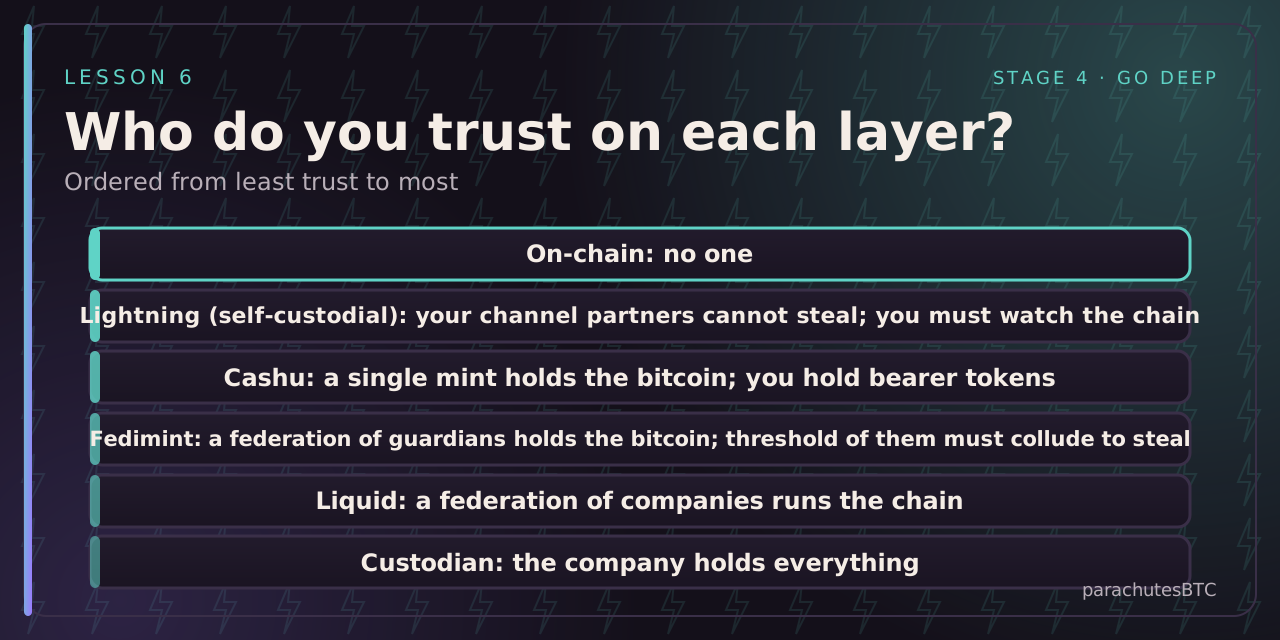
Lightning is the main layer but not the only one. Each of these answers a different need, and each asks you to trust someone.
Liquid
A sidechain: a separate blockchain pegged to bitcoin, run by a federation of companies (exchanges, wallets, Blockstream). Faster one-minute blocks, confidential amounts, and issued assets such as stablecoins. You trust the federation not to collude. Used mostly by traders and exchanges.
Fedimint
Federated e-cash. A community (a village, a group of friends, a church) runs a mint with several guardians; a threshold of them must agree to move bitcoin. Users hold Chaumian e-cash tokens, which are private even from the guardians, and pay out over Lightning. You trust the guardians as a group, which works best when you know them.
Cashu
Single-mint e-cash on Lightning. A mint holds bitcoin and issues bearer tokens; you can hold them, send them like cash, and redeem over Lightning. Excellent privacy and simplicity; you trust the one mint completely. Good for small amounts and for people in places where a trusted local mint beats a bank.
Custodians
Exchanges and apps that move numbers in a database and settle on-chain in batches. Instant and free internally, with full trust in the company and no privacy from it. The oldest "layer", and the one with the longest record of failures.
The picture
Every layer above the chain trades trust for something. The healthy ecosystem is one where people choose deliberately: Lightning for everyday self-custodial payments, e-cash for privacy and simplicity at small scale, the chain for savings and settlement. What bitcoiners reject is calling a company's database "bitcoin".