
After this lesson you can: sort any platform into one of three groups, say what each group is good and bad at, and open a shortlist with the right questions ready.
Three groups
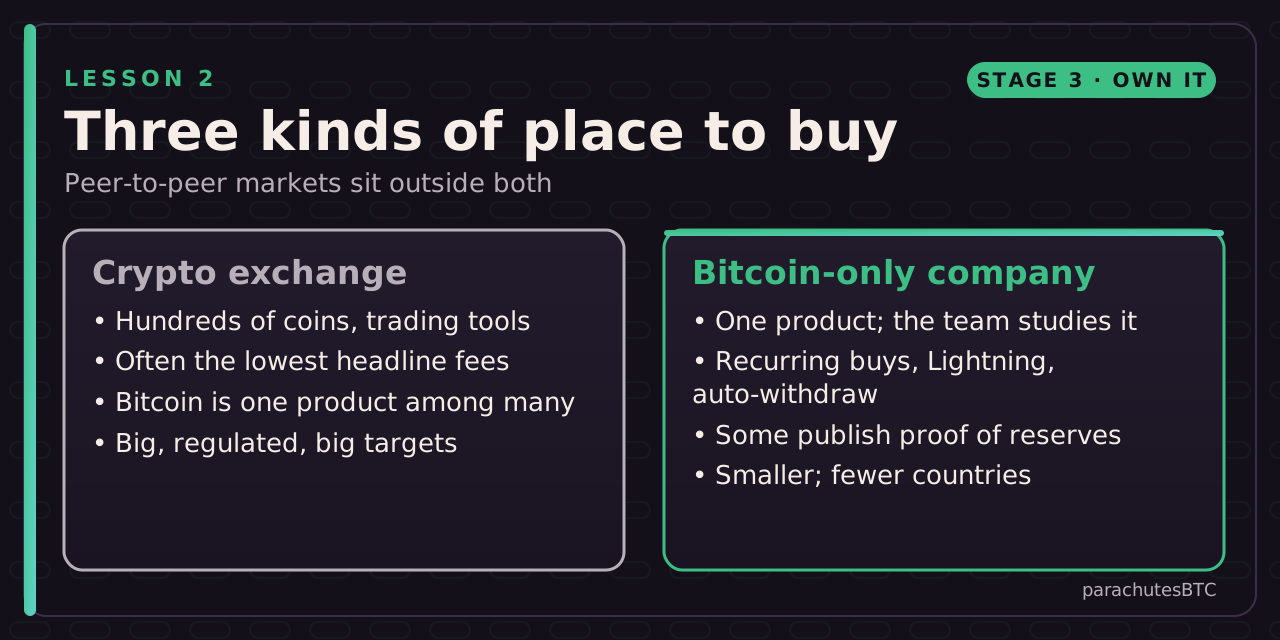
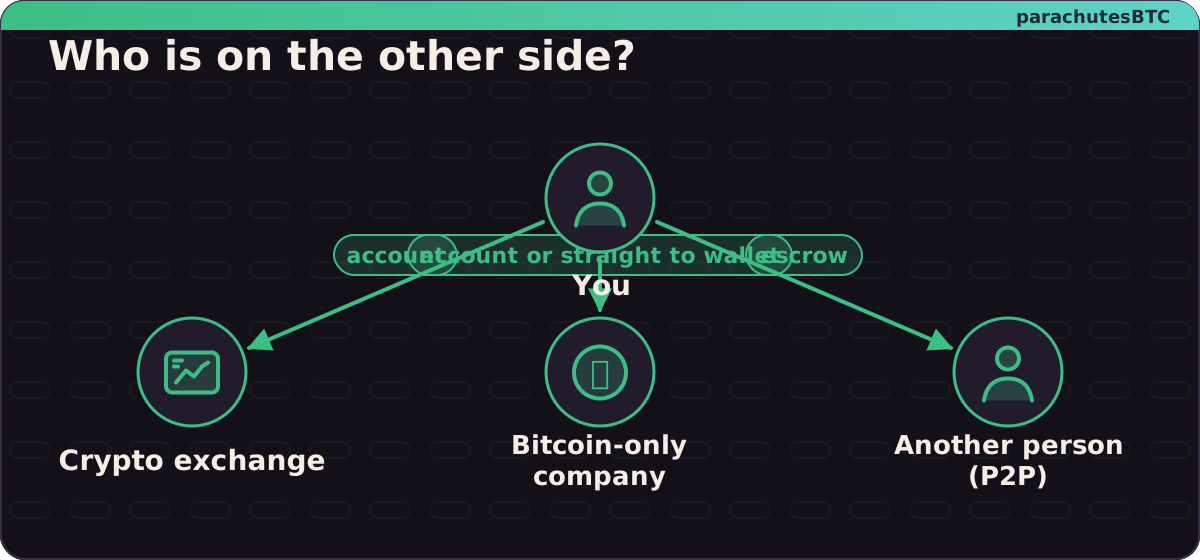
Crypto exchanges list hundreds of tokens. Bitcoin is one line on the menu. They tend to have the deepest order books and the lowest headline fees, and because they are large and regulated they are also large targets and large sources of leaked customer data. Their interfaces are built for trading, which is not the same as saving.
Bitcoin-only companies sell one thing. The trade-off is fewer features and fewer supported countries, in exchange for a team whose whole job is bitcoin: recurring buys, Lightning withdrawals, automatic withdrawal to your wallet, and in some cases a published proof of reserves. Several of them do not even custody the coins; the purchase lands straight in a wallet you control.
Peer-to-peer markets match you with another person. Your counterparty is a stranger, not a company, and the platform's job is escrow. No identity check, more effort, smaller amounts, and you learn the most.
The list
The links go to each company's own site. Availability depends on your country.
| Group | Example | Notes |
|---|---|---|
| Bitcoin-only (US) | River | Brokerage, recurring buys, Lightning, monthly proof of reserves, full reserve. The person behind this site uses River; referral link below. |
| Bitcoin-only (US) | Swan Bitcoin | Recurring buys with automatic withdrawal to your wallet. |
| Bitcoin-only (US and more) | Strike | Bitcoin and Lightning payments app with buying built in. |
| Bitcoin-only (Canada) | Bitcoin Well | Non-custodial: the buy is delivered to your own wallet. |
| Bitcoin-only (Canada, Europe) | Bull Bitcoin | Non-custodial, own wallet app. |
| Bitcoin-only (Europe) | Relai | Non-custodial app, recurring buys. |
| Crypto exchange | Coinbase | Largest US exchange; also custodian for several spot ETFs. |
| Crypto exchange | Kraken | Order book, lower tiered fees, publishes a Merkle-tree proof of reserves. |
| Peer-to-peer | Hodl Hodl | Non-custodial multisig escrow, no KYC. |
| Peer-to-peer | Bisq | Desktop app, decentralised, no company in the middle. |
| Peer-to-peer | RoboSats | Lightning-based, Tor, small amounts. |
Advantages and disadvantages, side by side
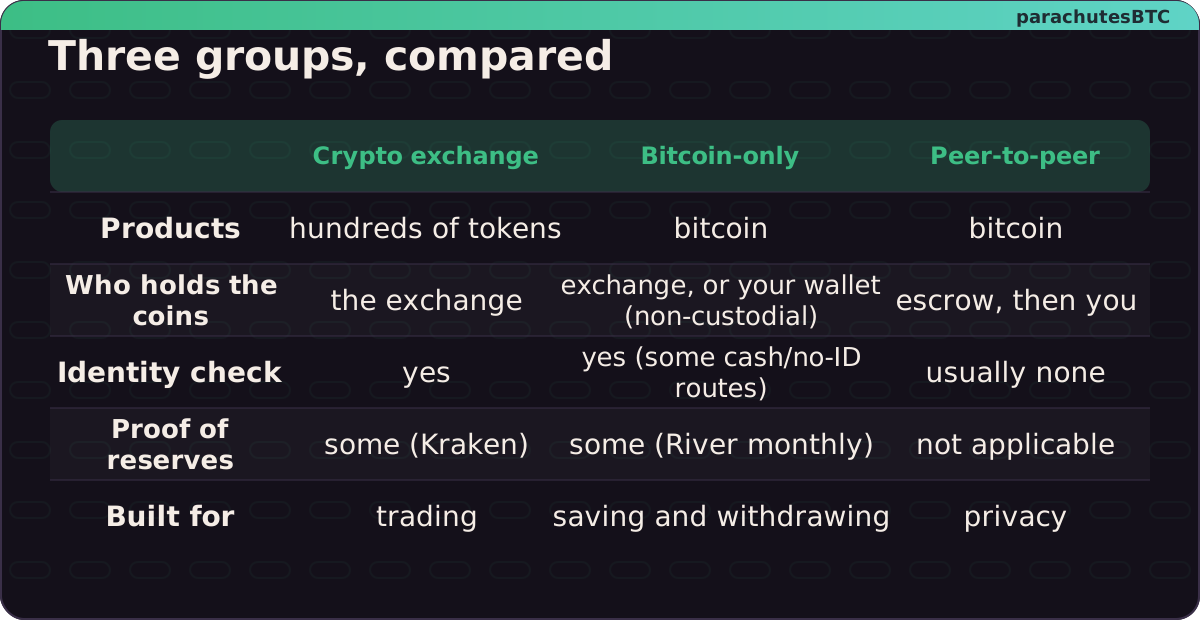
- Crypto exchange. For: liquidity, low fees at size, familiar. Against: your coins sit with a custodian that also holds a hundred other tokens' risks; the interface nudges you to trade; big data breaches have hit this category repeatedly.
- Bitcoin-only. For: features built around saving and withdrawing; proof of reserves at some; non-custodial options exist. Against: fewer countries, sometimes higher spreads, smaller companies.
- Peer-to-peer. For: privacy, no company between you and the seller. Against: effort, price premiums, limits on amount, and you must already have a wallet.
What to ask any of them
- Can I withdraw to my own wallet, and what does it cost? Is there a Lightning option?
- What is the all-in cost of a $100 buy, including spread?
- Does it publish a proof of reserves, and is the bitcoin held in full reserve? (Lesson 4.)
- What happens to my coins if the company fails? (Lesson 3.)
Open the sites of two platforms from the list and find each one's withdrawal fee for bitcoin. How many of the two publish it clearly?