
What a CBDC is
A central bank digital currency is a digital form of a national currency issued directly by the central bank. Instead of a bank deposit (a claim on a commercial bank) or cash (a bearer instrument), you would hold a balance on the central bank's own system. Most designs use a centralised database rather than a blockchain.
The pitch
Faster, cheaper payments; inclusion of the unbanked; a tool against crime; the ability to deliver stimulus instantly. Over a hundred countries, covering most of world GDP, have researched or piloted one. China's e-CNY is the largest live example; the EU's digital euro is in preparation; the US has debated and, for now, legislated against a retail version.
The problem
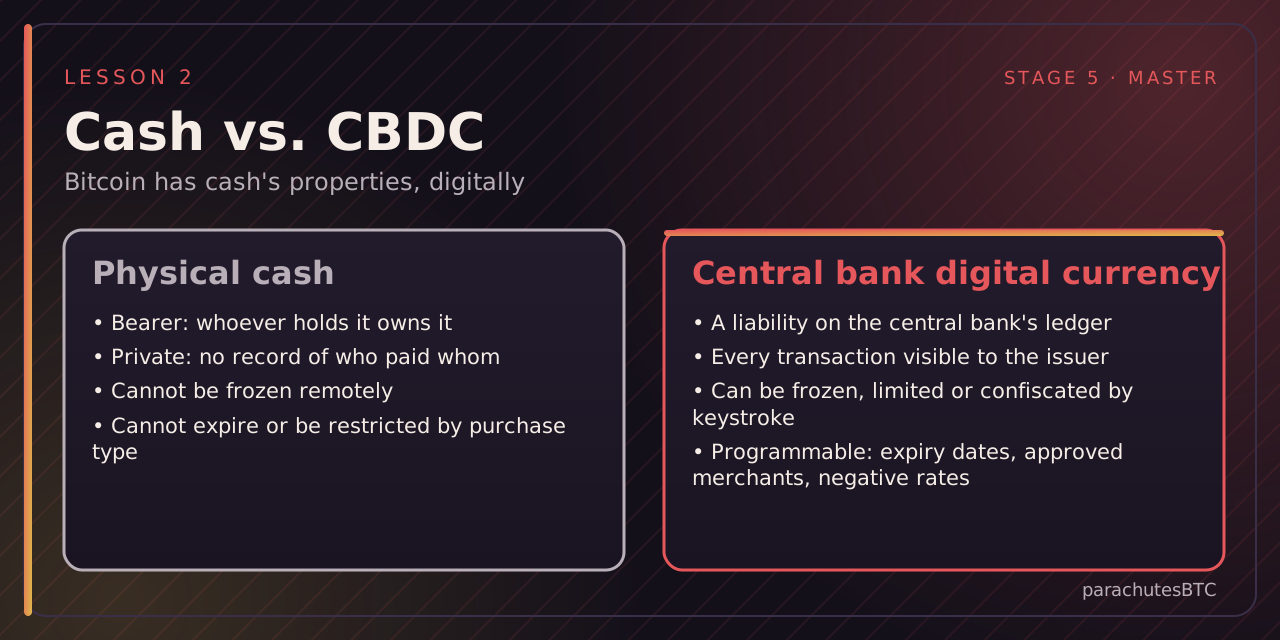
Everything cash cannot do, a CBDC can:
- Surveillance. Every transaction is visible to the issuer, in real time, forever.
- Freezing and confiscation by administrative decision, with no bank in between to refuse.
- Programmability. Money that expires if not spent, that works only at approved merchants, that cannot buy certain goods, that carries a negative interest rate you cannot escape into cash.
- Conditionality. Benefits, fines or access tied to behaviour, as some pilots have already tested.
In a democracy these would be constrained by law, for a while. Most of the world's population lives under governments that would not need to pretend. Once the infrastructure exists, every emergency is a reason to use it.
The contrast
Bitcoin is the technical opposite: a bearer asset with no issuer, that cannot be frozen in self-custody, cannot be programmed by a third party, and leaves a pseudonymous rather than an identified record. The two are competing answers to the same question: what should digital money be?