
The mechanism
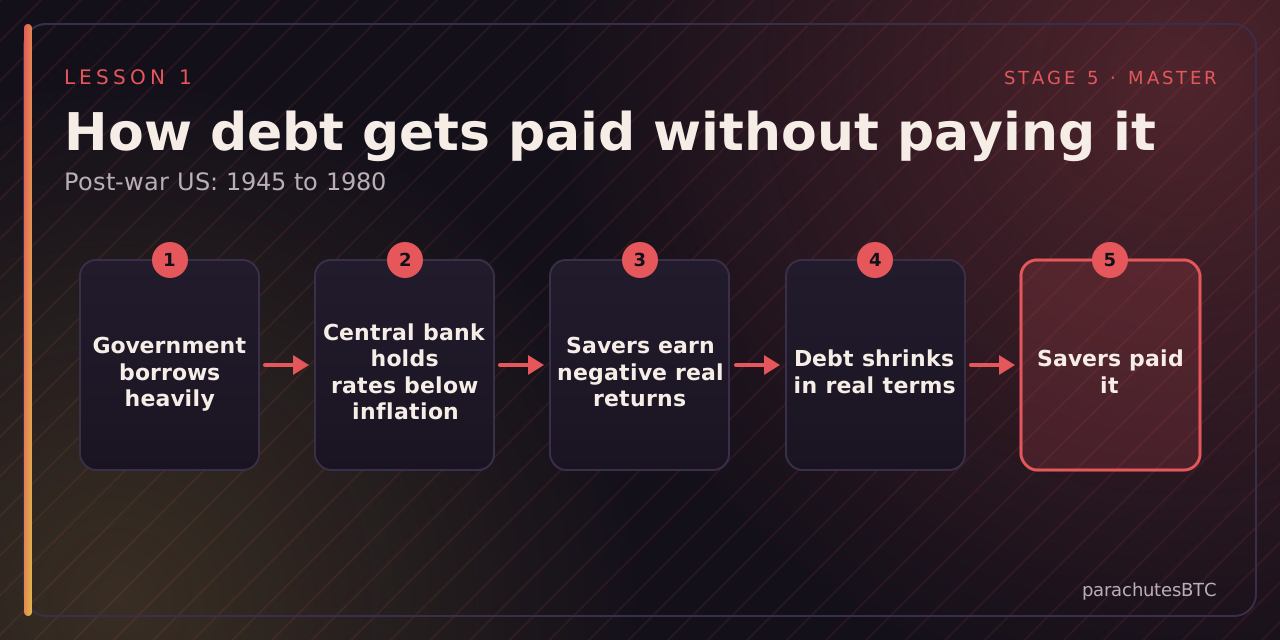
A government with large debts has four options: grow out of it, raise taxes, default, or inflate. Financial repression is the quiet version of the last: keep interest rates below the inflation rate for years, so the real value of the debt shrinks while nominal payments are made in full. Nobody votes for it; it shows up as a savings account that pays 1% while prices rise 4%.
The tools
- Interest rate caps and central-bank bond buying (quantitative easing, yield curve control) that hold yields down.
- Captive buyers: rules requiring banks, pension funds and insurers to hold government bonds.
- Capital controls to stop savings escaping to better returns abroad. Dozens of countries, covering over 40% of the world's population, have used them since 2000.
- Directed credit to favoured sectors.
The record
After the Second World War, US debt exceeded 110% of GDP. Over the following 35 years the Federal Reserve capped rates, real returns on government bonds were below 1% about two-thirds of the time, and debt fell to around 30% of GDP by 1980, mostly not by repayment but by inflation eating it. Since 2010 the policy rate has been below inflation most of the time again, and debt has passed 120% of GDP.
Who pays
Savers, pensioners, anyone paid in wages and holding cash. The transfer is from them to the borrower, which is the state and anyone else with fixed-rate debt. It is a tax that never appears on a ballot.
Why bitcoiners care
A money the state cannot issue cannot be repressed this way. Its holders can still be taxed, regulated or banned, but their savings cannot be quietly diluted to pay someone else's debts. That is the specific escape bitcoin offers, and the specific reason states notice it.
Your savings earn 1.5% while inflation is 4%. What is your real return, in percent?