
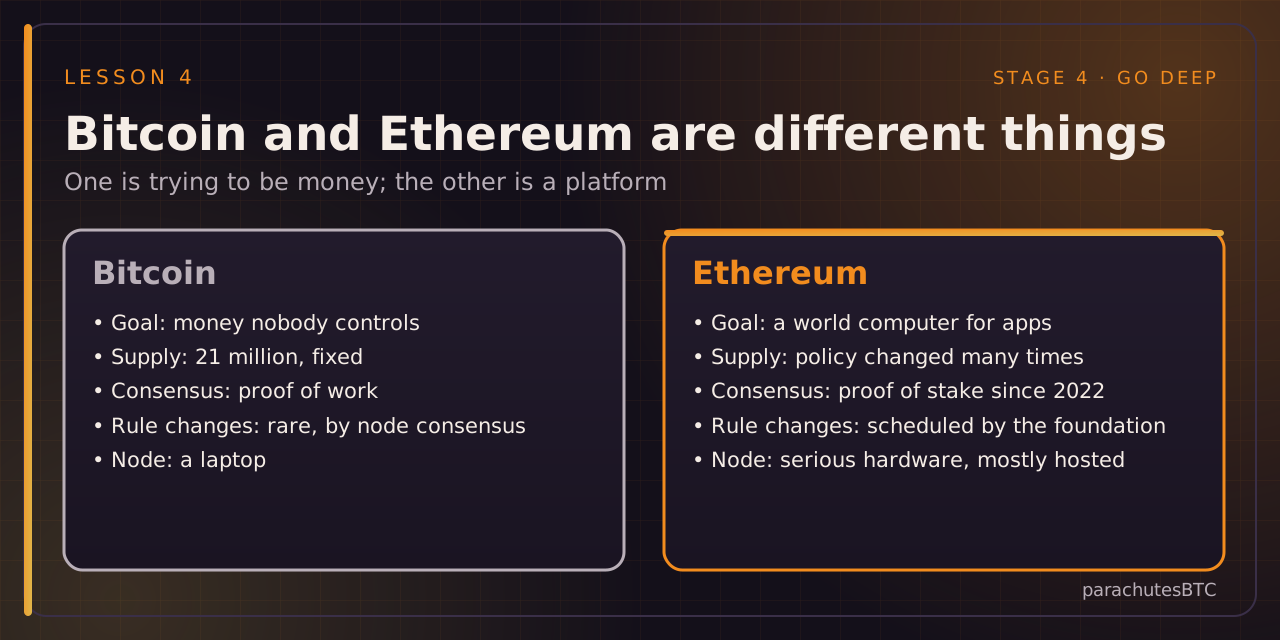
Ethereum is the most serious alternative, so it deserves a serious answer. The answer is not that it is useless; it is that it is a different kind of thing, and it fails the tests that money must pass.
Monetary policy
Bitcoin's supply schedule has never changed. Ethereum's issuance has been altered repeatedly by its developers: the "difficulty bomb" delays, the move to proof of stake, EIP-1559 fee burning. Each was arguably sensible. Each was a committee deciding how much money to make. A money whose supply is a committee decision is fiat.
Governance and the rollback
In 2016 a smart contract called The DAO was drained of about $60 million. Ethereum's leadership hard-forked to reverse the theft. The minority that refused became Ethereum Classic. Whatever you think of the choice, it proved a decision-maker exists, and that "code is law" lasts until the insiders lose money.
Decentralisation in practice
Ethereum's pre-mine put most early supply with insiders. Running a full archival node takes serious hardware, so most "nodes" rely on a few hosting providers. Since the move to proof of stake, a handful of staking services control a majority of validation.
The platform argument
Ethereum's defenders say it is not trying to be money; it is a computer for applications. Fine. Then compare it with platforms, not with bitcoin. The question this course asks is "what is the best money", and a platform governed by a foundation with a flexible supply is not a candidate.