
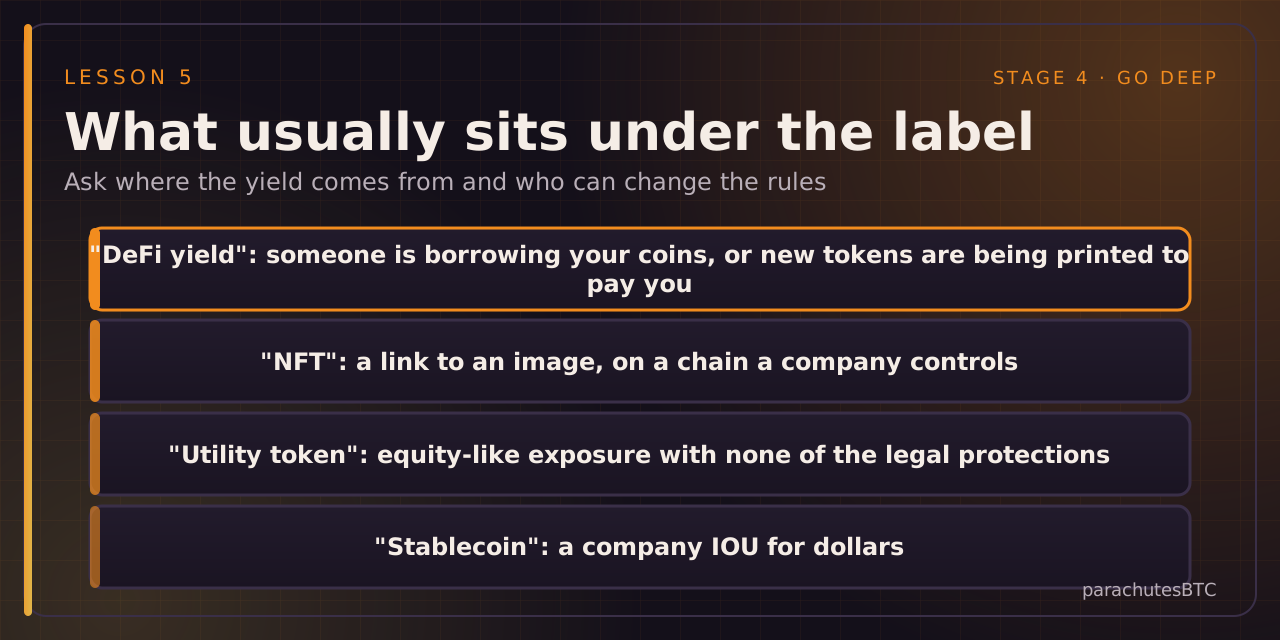
The parts of "crypto" that are not Bitcoin are mostly familiar financial products rebuilt without the rules, plus some things that are not products at all.
"DeFi" and yield
If something pays you 8% to hold it, ask where the 8% comes from. There are two answers: someone is borrowing your coins (and may not return them), or the protocol is printing new tokens to pay you (which dilutes everyone, including you). Bitcoin has no native yield because it has no issuer and no borrower built in. "Bitcoin yield" products are lending products, and 2022 showed how those end: Celsius, BlockFi, Voyager and FTX all paid yield until they could not.
NFTs
A non-fungible token is usually a pointer, stored on a chain, to an image hosted somewhere else. The image can vanish; the chain can be rolled back; the marketplace can delist. The 2021 mania was a collectibles bubble with a technology story attached. There are honest uses for unique digital records; the mania was not one of them.
Tokens
Most tokens are shares in a project, sold to the public without the disclosure a share sale would require. Insiders hold the majority, the supply schedule is whatever the foundation decides, and the token's purpose is to be sold. About 90% of retail crypto traders lose money, and the top ten tokens have trailed a bitcoin-only strategy over every multi-year period.
The common thread
All of these have a centre: an issuer, a foundation, a company, a lender. Bitcoin's value proposition is the absence of exactly that. Adding "crypto" to a bitcoin position does not diversify it; it adds counterparty and issuer risk that bitcoin was designed to remove.