
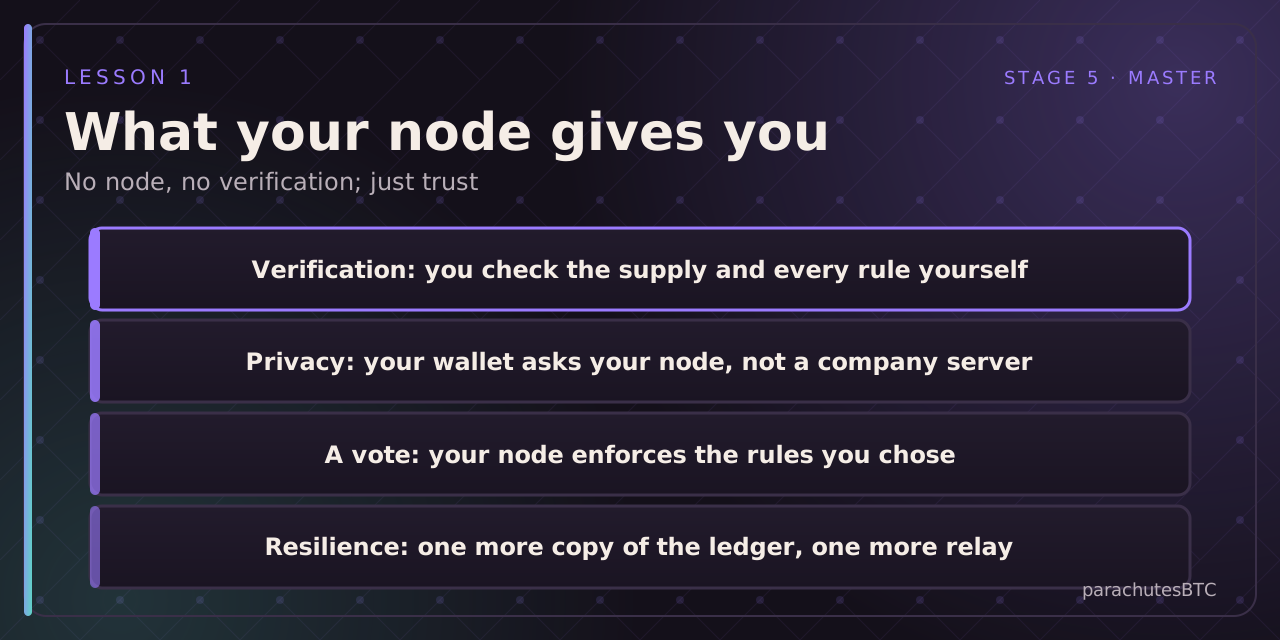
When you use a wallet without your own node, every balance you see and every transaction you trust comes from someone else's node: your wallet company's, an exchange's, a public explorer's. You are trusting that they run the right rules and tell you the truth. A node removes that trust.
What a full node does
- Downloads every block since 2009 and verifies every transaction against the consensus rules: signatures, no double spends, subsidy, proof of work, size, script.
- Maintains the UTXO set, so it knows exactly which coins exist and who can spend them. It verifies the supply directly: there are, as of your node's tip, this many bitcoin.
- Relays valid transactions and blocks to peers, and refuses invalid ones.
- Answers your wallet's questions privately.
Why it matters
- Verification. "21 million" is a claim until your software counts them. A node counts them.
- Privacy. A light wallet sends your addresses to a server. Your node answers from local data; nobody learns what you hold.
- A vote. Rules are whatever nodes enforce. In any future dispute, your node enforces your choice.
- Independence. If an exchange, a wallet company or a block explorer lies, goes down or is compelled, your view of the chain is unaffected.
Common misconceptions
Running a node does not earn bitcoin; that is mining. It does not require a powerful machine; a small single-board computer suffices. It does not need to be online always, though it is more useful if it is. It is not for experts; the turnkey options are an afternoon.
CHECK YOURSELF
pick an answer for each question