
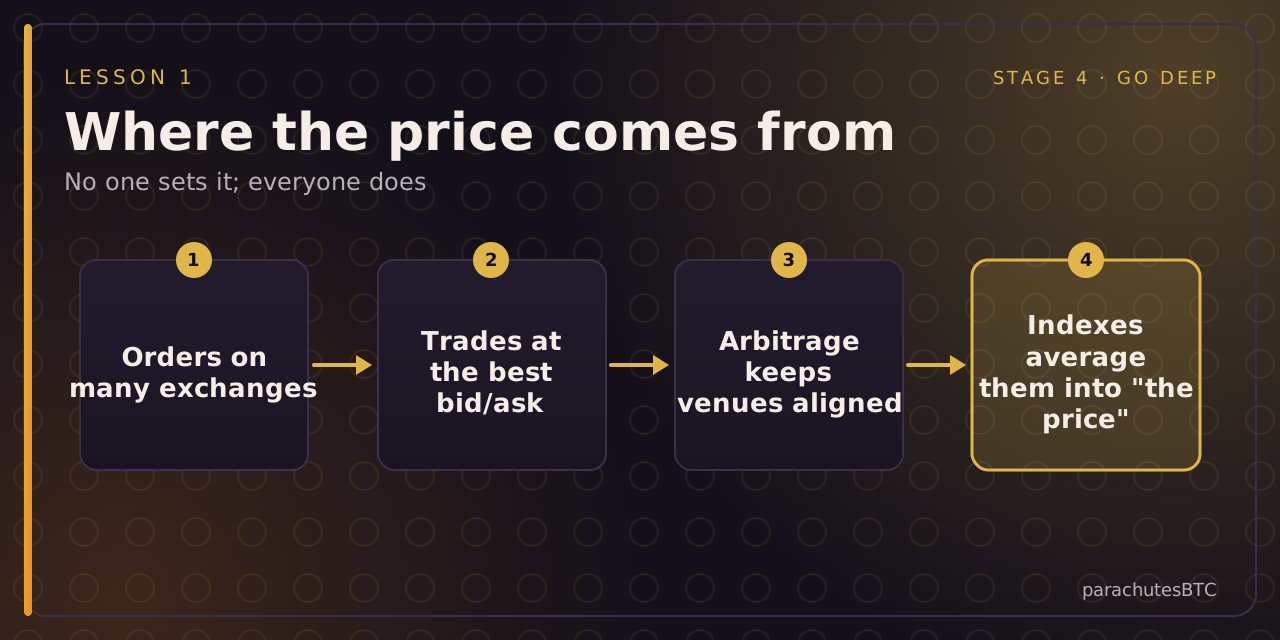
There is no central bitcoin market and no official price. Hundreds of exchanges run order books in dozens of currencies, 24 hours a day. The price you see is an index: an average of recent trades on major venues.
Supply and demand, with a twist
Price moves when buyers or sellers change their minds. The twist is that bitcoin's supply is fixed and arriving on a schedule, so every change in demand shows up entirely in price. Miners sell some of what they mine to pay costs, which is a small steady supply of sellers; everything else is existing holders deciding to sell or not.
Keeping markets aligned
If bitcoin is cheaper in Seoul than in New York, traders buy in one and sell in the other until the gap closes. This arbitrage keeps global prices within a fraction of a percent, except where capital controls block it (Korea's "kimchi premium", Nigeria's, Argentina's).
What moves it
Flows: ETF inflows, exchange withdrawals, corporate and sovereign buying, miner selling. Liquidity: when global money is loose, bitcoin tends to rise with other risk assets; when it tightens, it falls harder. Narrative: adoption news, regulation, hacks. And the long cycle of the next lesson.
What does not
Bitcoin's "fundamentals" are not earnings. The on-chain data (active addresses, holder age, exchange balances) tells you about usage and holder behaviour, not about a fair price. Anyone quoting a fair value is modelling, not measuring.