
If you bake bread and I fix roofs, we can only trade directly when each of us wants what the other has. Money solves that. You take it for your bread because you expect someone else to take it for their work. It is a tool for moving value between people, and across time.
The three jobs
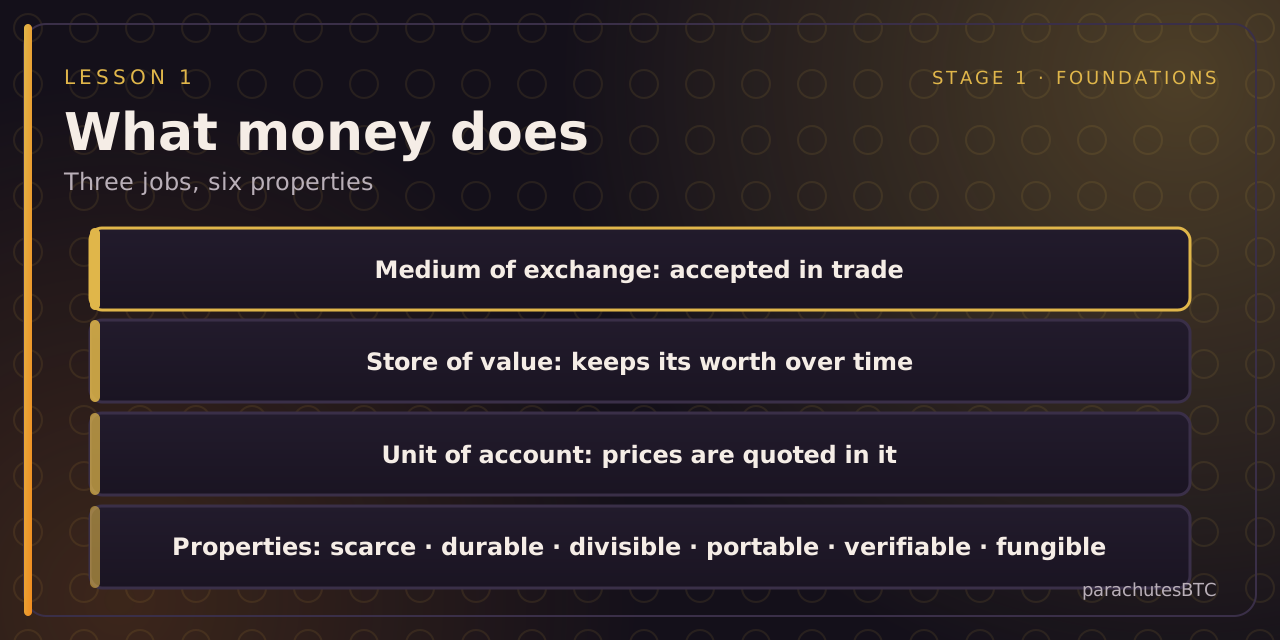
- Medium of exchange. It is accepted in trade. This is the job everyone sees.
- Store of value. It keeps its worth from today until you need it. This is the job that quietly fails in most currencies.
- Unit of account. Prices are quoted in it, so you can compare a loaf with a roof repair.
A money can do one job well and another badly. The US dollar is an excellent medium of exchange and a poor long-term store of value. Gold is a strong store of value and an awkward medium of exchange: try paying for coffee with it.
The six properties
Over thousands of years, the things people chose as money tended to share a few traits:
- Scarce. Hard to make more of. If anyone can produce it, it stops holding value.
- Durable. It does not rot, rust or wear away.
- Divisible. You can pay for something small or large.
- Portable. Easy to carry and, today, easy to send.
- Verifiable. You can tell it is genuine.
- Fungible. Each unit is the same as every other, so you never have to inspect which one you got.
CHECK YOURSELF
pick an answer for each question
Next
Where did money actually come from? Not from governments. That is lesson 2.