
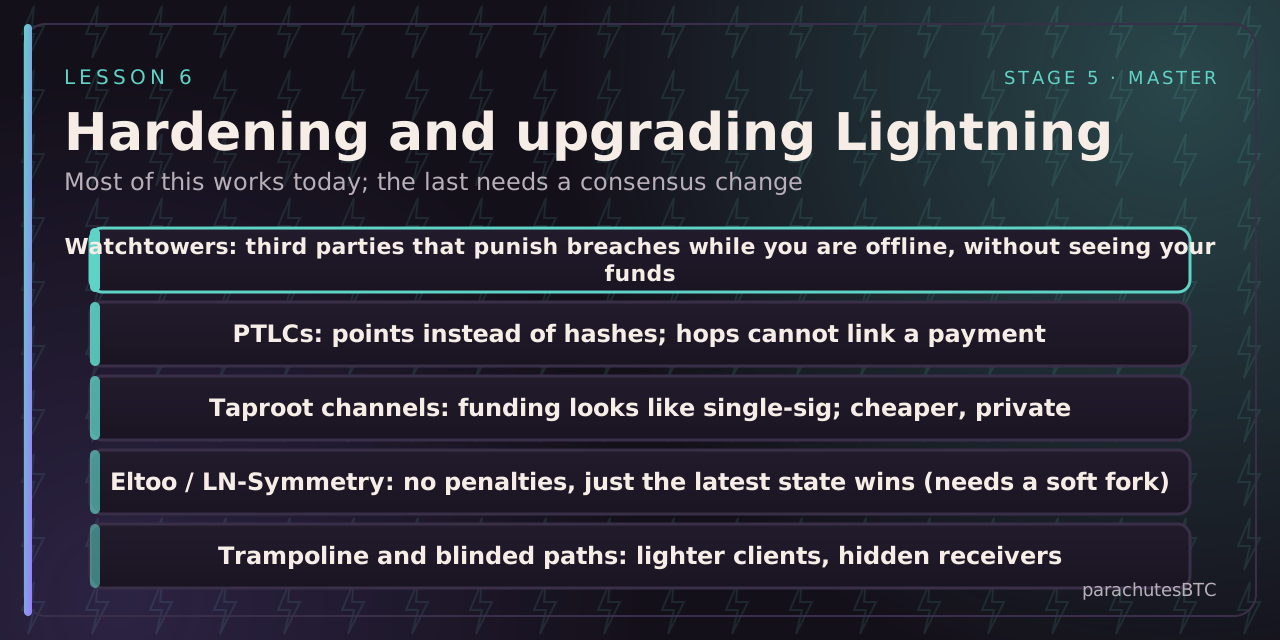
Watchtowers
The penalty mechanism only works if you notice a breach within the delay. A watchtower is a service you give encrypted penalty transactions to; it watches the chain for the matching commitment and broadcasts the punishment if it appears. It cannot read your channel balances or spend your funds, because the data it holds only decrypts when the breach transaction itself is published. Several implementations support them; some wallets run one for you.
PTLCs
Point timelock contracts replace the hash in an HTLC with a point on the curve, using Schnorr adaptor signatures. Each hop's lock is tweaked by a different amount, so two nodes on the same route can no longer see they share a payment. PTLCs also enable stuckless payments and better atomic swaps. They depend on Taproot, which is now in place.
Taproot channels
With Taproot, a channel's funding output is a MuSig2 aggregate key: on-chain it is indistinguishable from a single-sig payment, and cooperative closes are smaller and cheaper. The spec is finalised and implementations are shipping.
Eltoo / LN-Symmetry
The penalty design requires storing every old state's revocation secret and punishing breaches. Eltoo would instead let the latest state always override older ones, so publishing an old state is simply corrected rather than punished. Simpler backups, safer multi-party channels. It needs a new signature flag (SIGHASH_ANYPREVOUT), which is a soft fork that has not activated; see the governance course.
Blinded paths and trampoline
Blinded paths let a receiver hide its node behind an encrypted route segment (used in BOLT 12). Trampoline routing lets a light wallet hand pathfinding to a trusted node without giving up custody, easing mobile use.
The honest state
Lightning in 2026 is far more reliable than in 2019 and still has rough edges: channel backups, liquidity management, and the dependence on on-chain fee predictability. Most of the fixes above are in progress rather than in your pocket. Knowing which is which is what this course was for.