
Submarine swaps
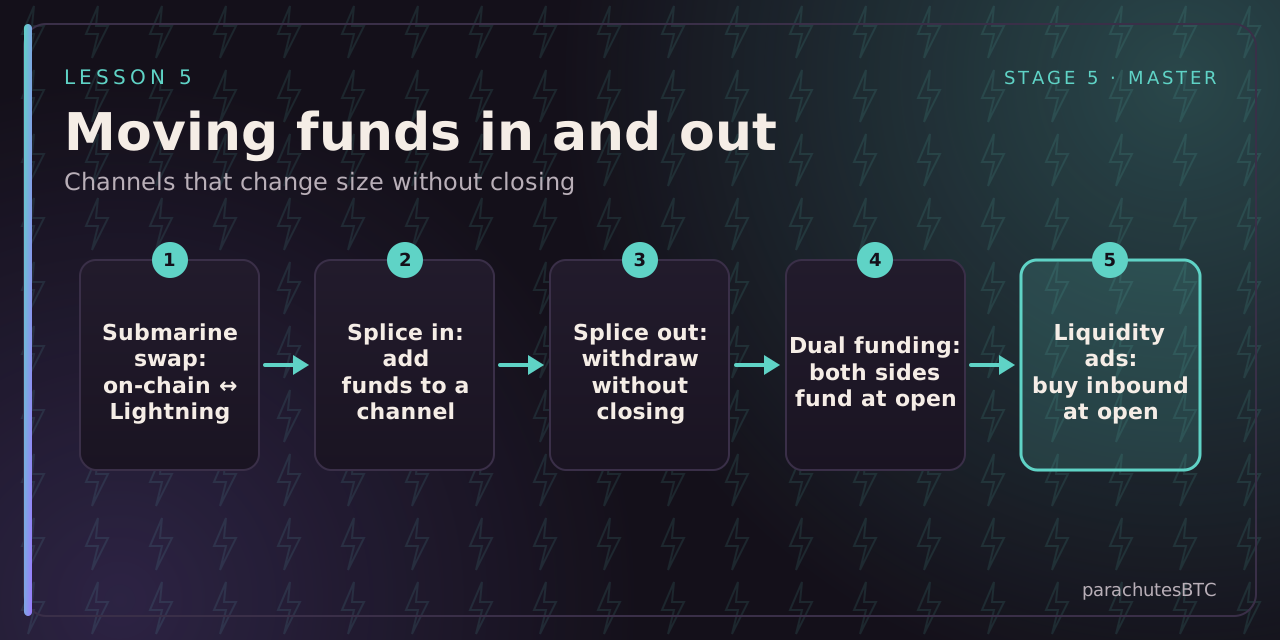
A trustless exchange between an on-chain payment and a Lightning payment, built from the same HTLC idea: you pay on-chain to an HTLC; the swap provider pays you over Lightning; revealing the preimage settles both. Used to move savings onto Lightning, to drain a channel to cold storage, and by wallets to fill inbound liquidity ("loop in" and "loop out").
Splicing
Historically, changing a channel's size meant closing and reopening: two on-chain transactions and downtime. Splicing replaces the funding output with a new one in a single transaction while the channel keeps operating. Splice in adds funds (say, from cold storage); splice out withdraws (say, to pay an on-chain invoice) without closing. Implemented in several clients and spreading.
Dual funding and liquidity ads
In the original protocol only the opener funded a channel, so new nodes had no inbound liquidity. Dual funding lets both sides contribute at open. Liquidity advertisements let nodes publish a price for inbound liquidity; a wallet can open a channel and buy inbound in the same transaction. Consumer wallets use these, or equivalent services, so first-time users can receive.
Channel factories and the future
Proposals would let many channels share one on-chain output, cutting the on-chain cost of onboarding users; some depend on covenant soft forks. For now, splicing and swaps already make a Lightning balance something you can grow and shrink without touching the chain much.