Before you start: Coins on an exchange or brokerage, and the wallet from the previous lesson.
IN THIS LESSON · 6 OF 10
BY THE END YOU WILL BE ABLE TO ANSWER
Why send a small test withdrawal first?
When is Lightning the better rail for a withdrawal?
What does an on-chain fee depend on?
Your exchange charges a flat 0.0002 BTC to withdraw on-chain. On a $50 withdrawal at $100,000 per BTC, what percentage is the fee?
Then prove it: a 3-question quiz · a challenge. The lesson marks itself complete at 100%.
After this lesson you can: take coins off an exchange and into your own keys, and know whether Lightning or on-chain is the right rail for the amount.
Why this is the lesson that matters
Everything in lesson 3 comes down to one action. Until you withdraw, you hold a claim. After you withdraw, you hold bitcoin. Many platforms make this easy; some bitcoin-only companies do it automatically on a schedule, and the non-custodial ones skip the step entirely because the coins never sat with them.
Steps
Fees, briefly
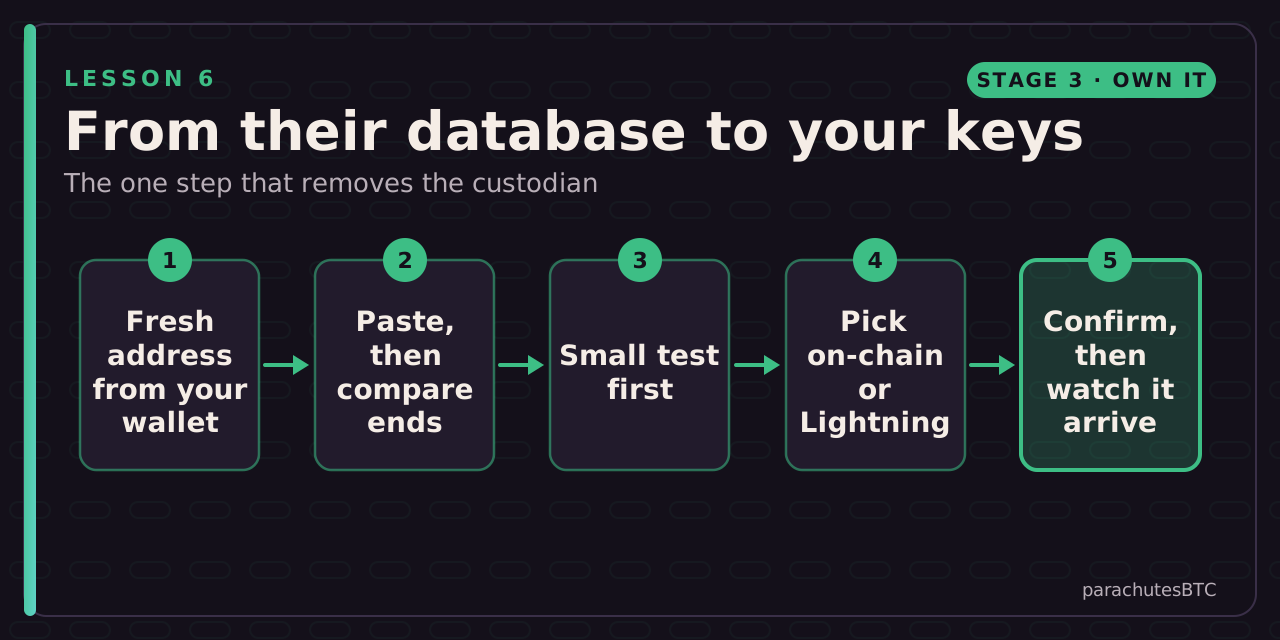
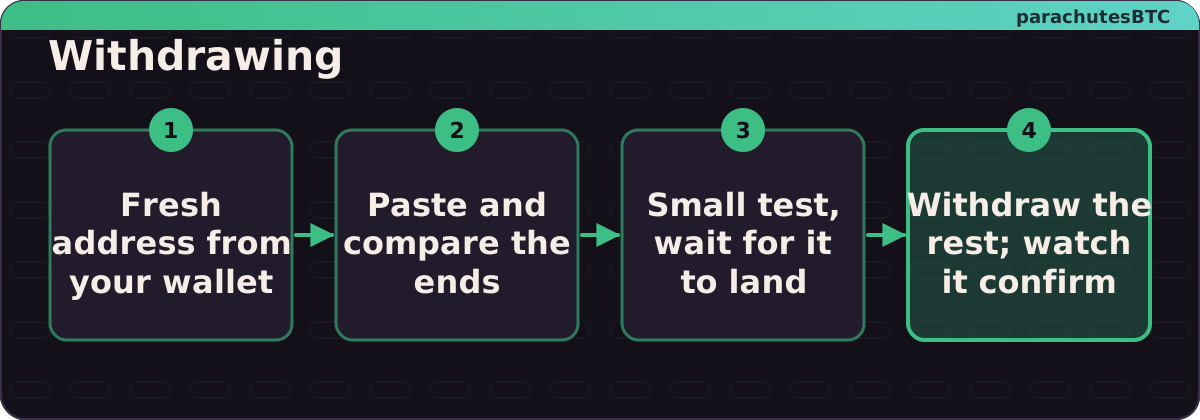
Test first, then the rest. The exchange's job ends at the arrow.
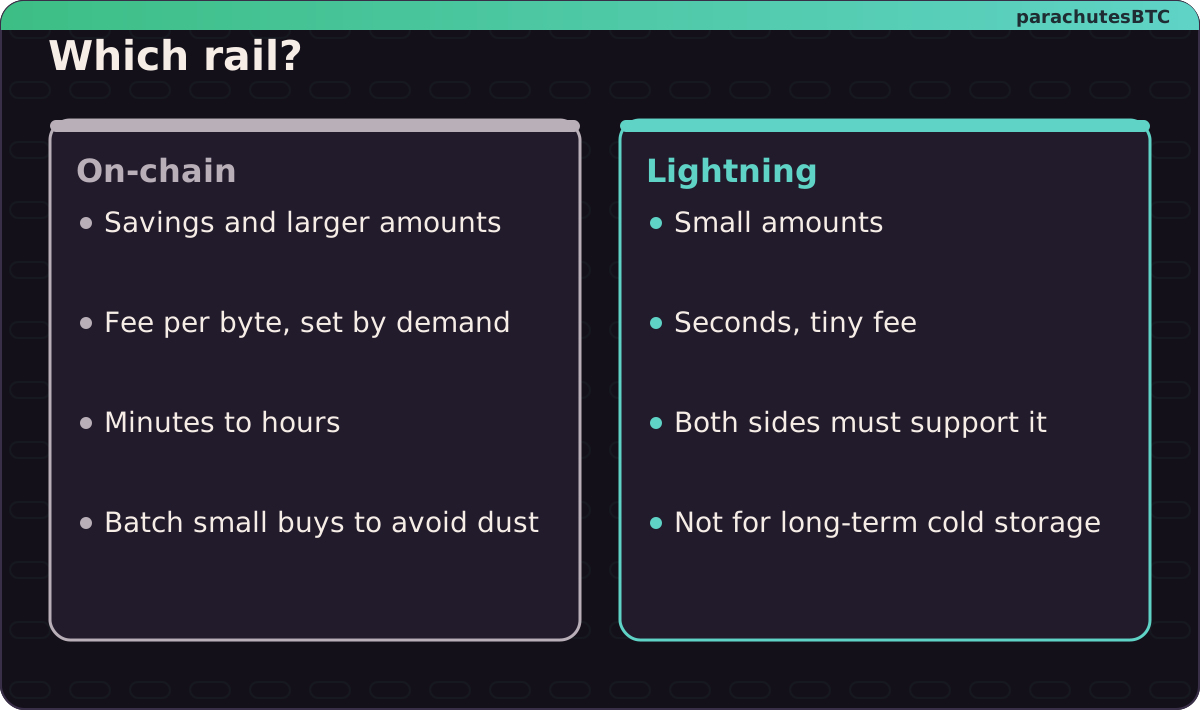
An on-chain fee is paid per byte of transaction data to miners, so it is the same whether you move $50 or $50,000. When the network is busy, fees rise. Check mempool.space for the current rate. Withdrawing weekly in tiny amounts builds up many small outputs that are expensive to spend later; the Self-custody course covers that (UTXO management).
Quickly Get Bitcoin With This Simple Step-By-Step Guide · BTC SessionsWatch on YouTube ↗
Pick the rail by amount and purpose.
MINI CHALLENGEFee check
Your exchange charges a flat 0.0002 BTC to withdraw on-chain. On a $50 withdrawal at $100,000 per BTC, what percentage is the fee?
percent
0.0002 BTC is $20.
40%. Batch small buys, or use Lightning for small amounts.
01Because a wrong address is irreversible, and a test proves the path works before the real amount movesA few dollars of insurance against a typo or malware.
02For small amounts, when both the exchange and your wallet support itSeconds and tiny fees for small sums; on-chain for savings.
03The size of the transaction in bytes and current network demandThe same fee for $50 or $50,000 of the same transaction shape.