
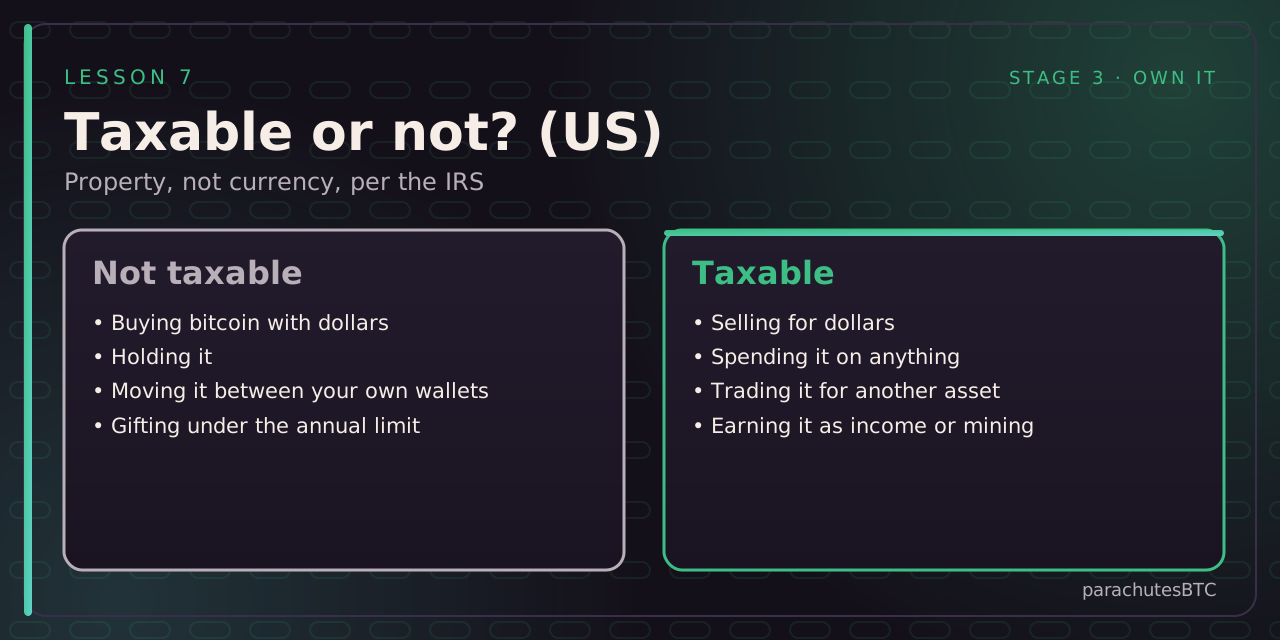
This lesson describes the general rules in the United States as of 2026. It is education, not tax advice; rules change and your situation is your own.
Property, not currency
The IRS has treated bitcoin as property since 2014. That means capital gains rules apply, like stocks or real estate.
What is not a taxable event
- Buying bitcoin with dollars.
- Holding it, however long.
- Moving it between wallets or accounts you own.
- Gifting it below the annual exclusion (about $19,000 per recipient in 2025).
What is
- Selling for dollars.
- Spending it on goods or services (a sale at that moment's price).
- Trading it for another asset.
- Earning it: wages, mining, rewards and interest are ordinary income at the value when received.
Gains and holding periods
Gain is the sale value minus your cost basis (what you paid, including fees). Held one year or less, it is a short-term gain taxed as ordinary income. Held over a year, it is long-term, taxed at 0 to 20% depending on income. Losses offset gains and up to $3,000 of ordinary income a year, with the rest carried forward.
Records and forms
From 2026 US brokerages report your sales and cost basis on Form 1099-DA. Sales go on Form 8949 and Schedule D. Keep your own records anyway, especially for coins moved between platforms, because a broker only knows what happened on its platform. Accounting is wallet-by-wallet, and FIFO is the default unless you specify lots.
The Taxes and estate planning course goes deeper.