
The strongest version
Bitcoin produces nothing. Its price only rises if someone later pays more. Early holders cash out on late arrivals. That is a Ponzi, or at best a greater-fool game.
What a Ponzi actually is
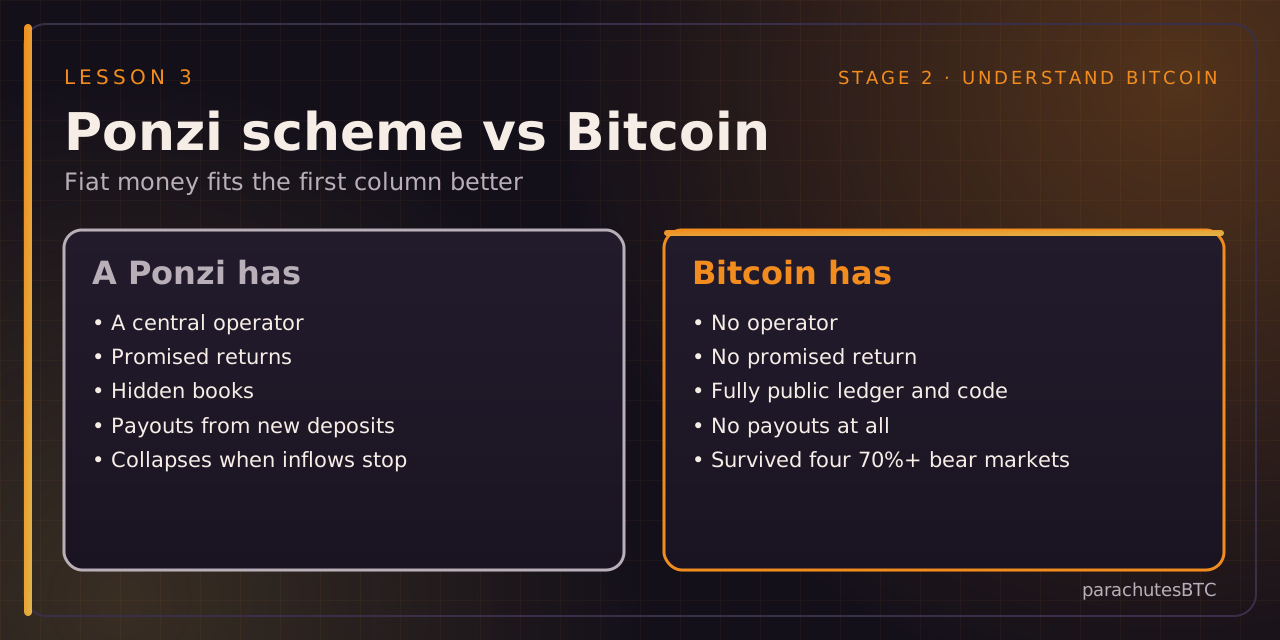
Charles Ponzi promised 50% returns in 45 days and paid early investors with later investors' money. The defining features: an operator, a promised return, concealment, and dependence on new deposits to make payouts. When inflows stop, it collapses because the payouts stop.
Why Bitcoin is not one
- There is no operator and no one to promise anything.
- There are no payouts. Nobody is owed a return.
- Everything is public: the code, the ledger, the supply.
- When inflows stopped, in 2014, 2018 and 2022, the price fell 70 to 85% and the network kept running, because nothing had to be paid to anyone.
"But it produces nothing"
Neither does gold, land held empty, or a dollar bill. Monetary goods are valued for their monetary properties, not for cash flows. The question is whether bitcoin's properties are good enough that people keep choosing it as money. That is an open question with seventeen years of evidence, not a fraud.
The mirror
A currency with unlimited issuance, where new money pays for old promises, where the books are opaque and the system depends on ever-growing debt, fits the Ponzi definition better than bitcoin does. That observation is not an argument for bitcoin, but it should give the accusation pause.