
The strongest version
The state will not tolerate a money it cannot print. When bitcoin matters enough, it will be banned, as gold was in 1933.
What a ban can and cannot do
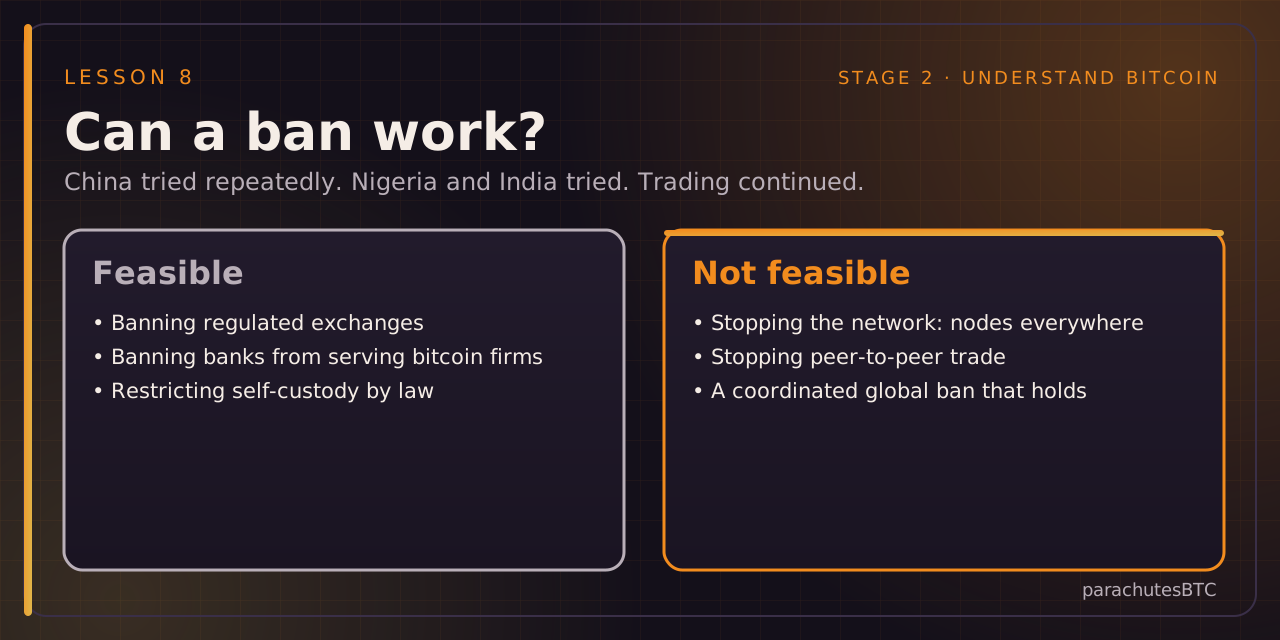
A government can ban banks from serving bitcoin businesses and shut regulated exchanges. It cannot shut down a network of tens of thousands of nodes on every continent, stop people trading peer-to-peer, or stop a seed phrase crossing a border in someone's head.
The record
- China has "banned" bitcoin several times since 2013. Mining left and partly returned; trading moved peer-to-peer; China remains a top mining country.
- India's 2018 banking ban was struck down by its Supreme Court in 2020.
- Nigeria banned banks from serving exchanges in 2021; peer-to-peer volume rose and the local premium widened.
- Gold in 1933 was confiscated from banks and safe-deposit boxes, which is where people kept it. Self-custodied bitcoin has no such choke point.
The trend
Since 2021 the direction has been the opposite of a ban: El Salvador made it legal tender, US spot ETFs launched in 2024, states and countries have proposed strategic reserves, and the largest asset managers sell it. Bans are now jurisdictionally costly: capital, companies and miners leave for friendlier places.
The more likely risk
Not a ban on bitcoin but restrictions on self-custody: licensing wallets, reporting rules, limits on withdrawals from exchanges. That achieves surveillance goals cheaply, and it is why holding your own keys and running a node are political acts as well as technical ones.