
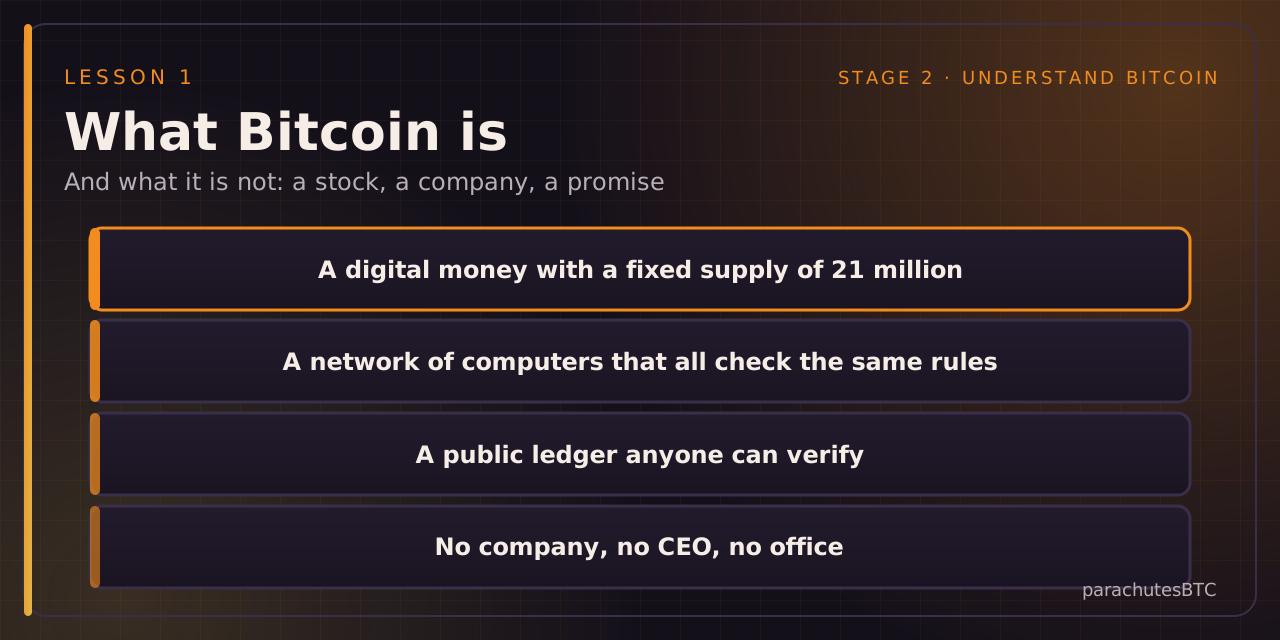
Bitcoin is a digital money. You can send it to anyone in the world, at any hour, without asking a bank. There will only ever be 21 million of it. Nobody owns the network, nobody can print more, and anyone can check that both statements are true.
Three things in one word
People use the word for three different things:
- Bitcoin, the network: thousands of computers running open-source software and agreeing on one shared record.
- The blockchain: that shared record, a list of every transaction since January 2009.
- bitcoin, the unit: the money itself, divisible into 100 million satoshis.
What it is not
It is not a company; there are no shares and no earnings. It is not a bank; no one holds your money for you unless you choose that. It is not a promise; it does not pay interest and nobody guarantees its price. It is a bearer asset, like cash or gold, that exists only as entries in a ledger that no one controls.
Why it exists
The 2008 whitepaper opens by naming the problem: online payments rely on trusted third parties, and trust has costs. Bitcoin was built to let two people transact without one.