
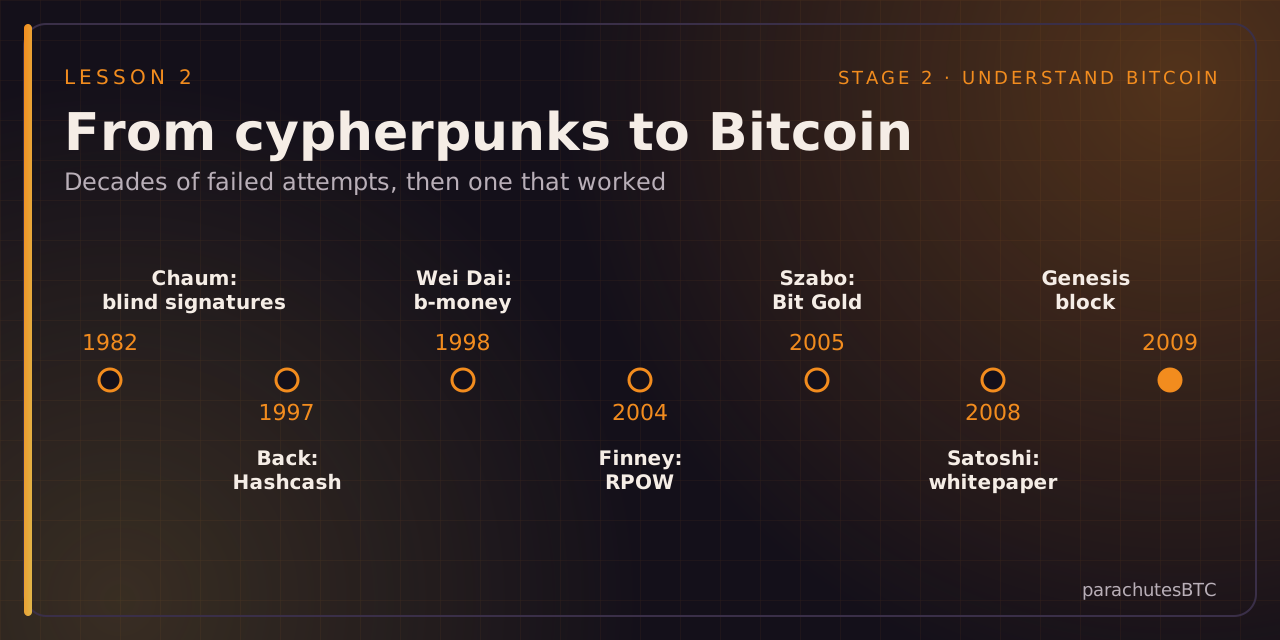
In the 1990s a loose group of programmers and activists called cypherpunks argued that privacy and freedom in a digital age would come from cryptography, not from asking permission. They tried, repeatedly, to build digital cash: David Chaum's DigiCash, Adam Back's Hashcash, Wei Dai's b-money, Hal Finney's RPOW, Nick Szabo's Bit Gold. Each solved part of the problem. None solved it fully without a trusted party.
The whitepaper
On 31 October 2008, in the middle of the financial crisis, someone using the name Satoshi Nakamoto posted a nine-page paper to a cryptography mailing list: "Bitcoin: A Peer-to-Peer Electronic Cash System". It combined the earlier ideas with one new one: a chain of blocks secured by proof of work, which lets strangers agree on who owns what with no referee.
The first years
- 3 January 2009: the genesis block, containing the headline "Chancellor on brink of second bailout for banks".
- 12 January 2009: the first transaction, 10 BTC to Hal Finney.
- 22 May 2010: two pizzas for 10,000 BTC.
- 2010 to 2011: Satoshi hands the code to others and stops posting. The last known message is from April 2011.
Satoshi mined roughly a million bitcoin that have never moved. The identity remains unknown; every claimant has been debunked, including in court. The disappearance was the point: a money with a founder is a money with a target.