
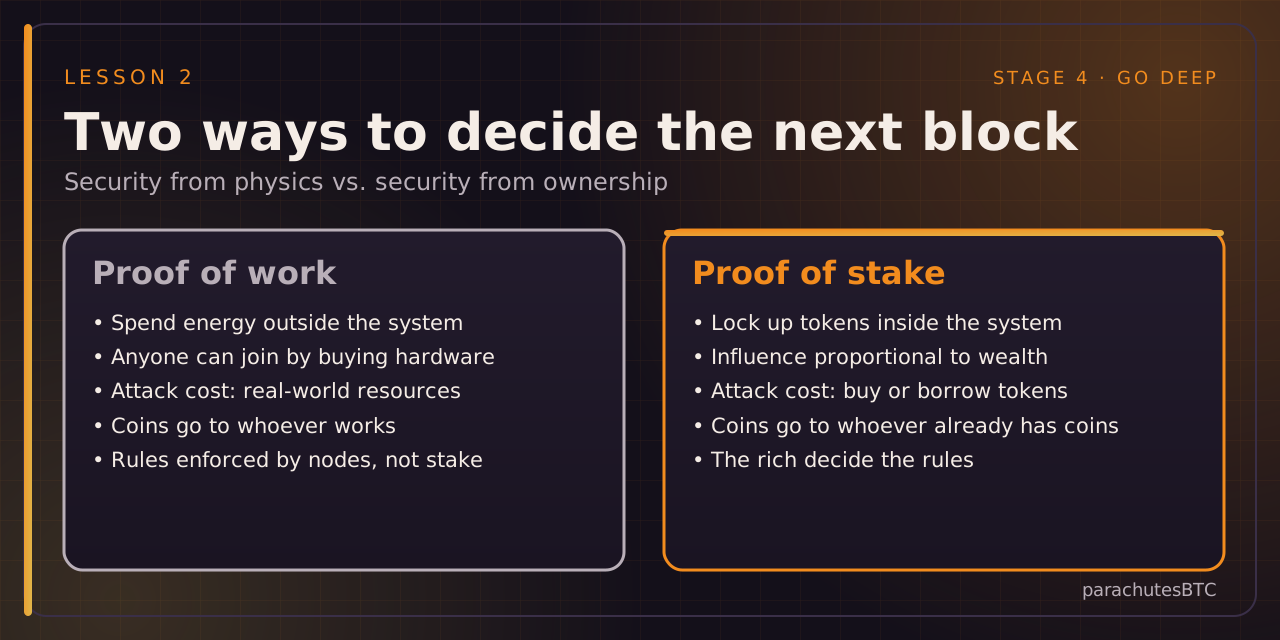
How each works
Proof of work: miners spend electricity to find valid blocks. Anyone can join by buying hardware and power. Influence costs resources from outside the system, every day.
Proof of stake: validators lock up the token and are chosen to produce blocks in proportion to their stake. Influence is proportional to existing wealth, and rewards go to those who already hold the most.
Why bitcoiners reject proof of stake
- The rich get richer by design. Staking rewards accrue to the largest holders, so concentration increases over time rather than decreasing.
- It recreates the thing it replaced. Whoever holds the most tokens sets the rules. On Ethereum, a handful of staking providers and exchanges control a majority of stake. That is a board, not a network.
- Nothing at stake, historically. Without an external cost, validators can cheaply support multiple chain histories; the fixes (slashing, checkpoints, "social consensus") put humans back in charge of which history is real.
- Attack cost is internal. To attack a proof-of-stake chain you buy or borrow tokens; to attack Bitcoin you must build and power hardware the rest of the world is also building, continuously.
- Issuance fairness. New bitcoin goes to whoever did work. New stake-coins go to whoever had coins.
The energy trade
Proof of stake uses almost no energy. That is its one real advantage, and the cost is everything above. Bitcoiners judge that a money worth securing is worth real energy, and that a money secured by wealth is just a cap table.
CHECK YOURSELF
pick an answer for each question