
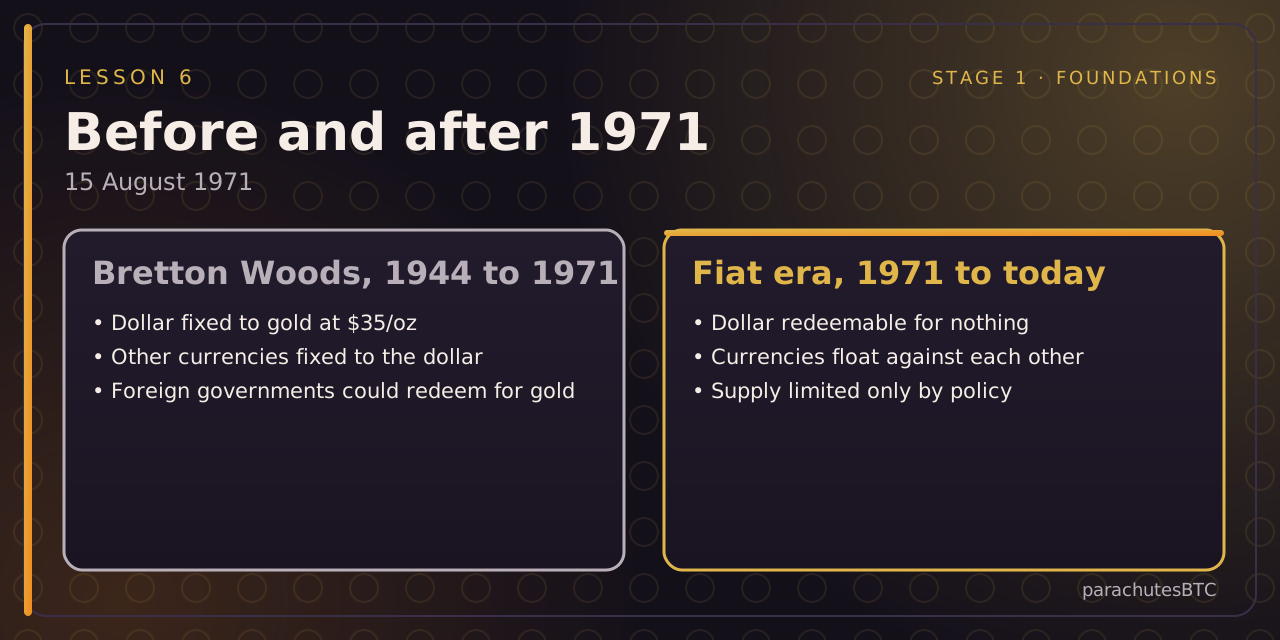
After the Second World War, the Bretton Woods agreement fixed the world's currencies to the US dollar and the dollar to gold at $35 an ounce. Foreign governments could turn dollars into gold on demand. That promise disciplined the printing press.
Through the 1960s the United States spent on war and welfare and printed to cover it. Gold began leaving the vaults as other countries, led by France, took the US at its word. US gold reserves fell by about half in the 25 years before 1971.
The Nixon shock
On Sunday 15 August 1971, President Nixon announced on television that the dollar would no longer be convertible to gold. It was called temporary. It never ended. By 1973 the major currencies floated freely, and the fiat era began.
What changed afterwards
Line up almost any long-term economic chart and you will see a bend in the early 1970s: productivity and wages, which had risen together, separate; house prices pull away from incomes; federal debt turns upward; the personal savings rate falls; households need two earners where one had been enough. Our Dollar Since 1792 dashboard lets you overlay these series yourself.
At $35 an ounce, how many ounces of gold could you get for $700 in 1970?
Next
Why do some people save and others spend everything? The quality of money changes behaviour. Lesson 7: time preference.