
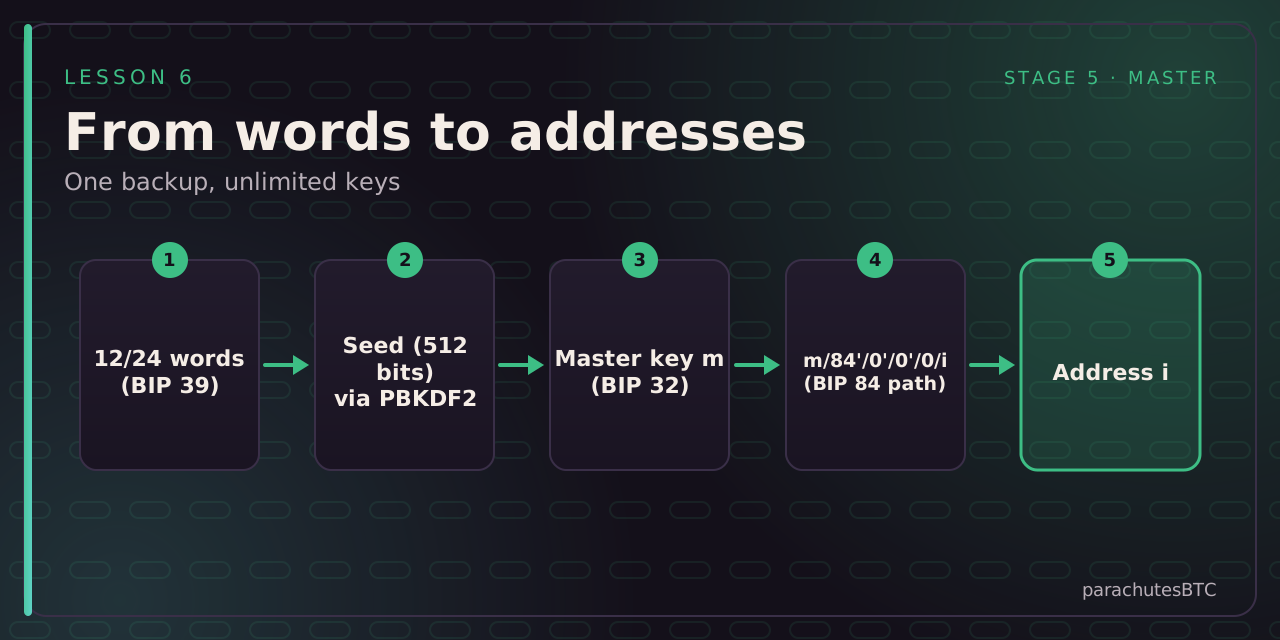
BIP 39: words to seed
Take 128 or 256 bits of entropy, append a checksum, and split into 11-bit chunks; each chunk indexes a 2,048-word list. That gives 12 or 24 words. The words plus an optional passphrase are run through a slow hash (PBKDF2, 2,048 rounds) to produce a 512-bit seed. The words are not the key; they are the recipe for it.
BIP 32: seed to tree
The seed produces a master private key and a chain code. From any key and chain code you can derive child keys by index, and from children, grandchildren, without limit. Hardened derivation (indices written with an apostrophe) uses the private key, so a leaked child cannot compromise the parent. Normal derivation lets a watch-only wallet derive public keys from an xpub without any private key.
Derivation paths
A path like m/84'/0'/0'/0/5 means: purpose 84 (native SegWit), coin 0 (bitcoin), account 0, external chain (0 for receiving, 1 for change), index 5. The purpose numbers come from BIPs: 44 for legacy, 49 for wrapped SegWit, 84 for native SegWit, 86 for Taproot. Wallets agree on these so a seed restores the same addresses anywhere.
Why paths matter
Restore a seed in a wallet that scans a different path and you will see an empty balance and panic. The coins are fine; the wallet is looking in the wrong branch. Record your derivation path and script type with your backup. Output descriptors are the modern way to write all of this in one string.
The gap limit
Wallets scan addresses in order and stop after 20 unused ones in a row. If you handed out many addresses that were never paid, a restore might miss later ones until you raise the gap limit.
In the path m/86'/0'/0'/1/3, what does the 1 in the fourth position mean?